
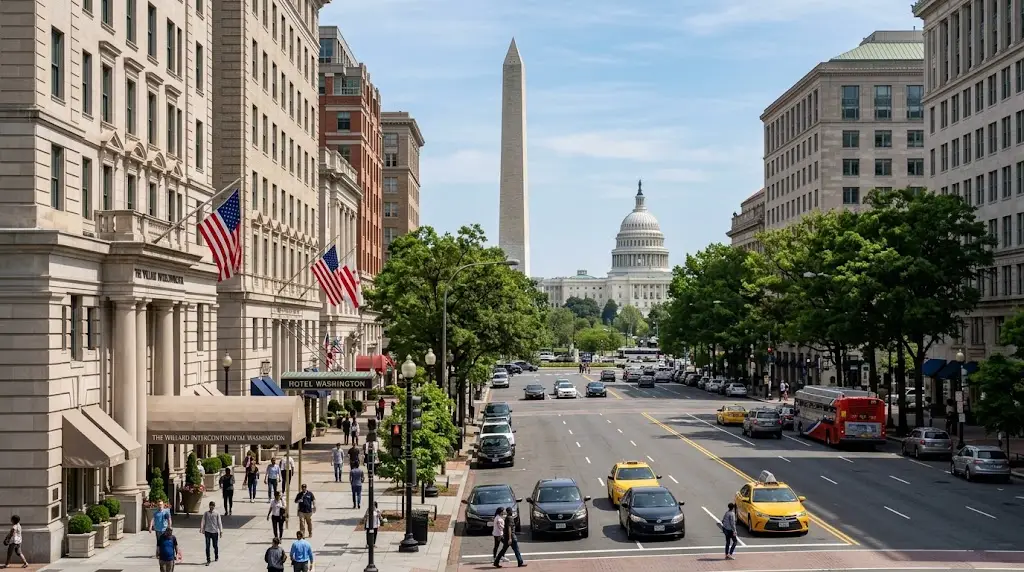
Washington, DC offers accommodation options for different budgets and travel styles. Downtown and Penn Quarter are convenient for first-time visitors, Capitol Hill appeals to families and history enthusiasts, Dupont Circle offers restaurants and neighborhood character, and Arlington, Virginia, can provide practical alternatives for budget-conscious travelers.
The best location depends on what you want to see, whether you plan to rent a car, how much walking you can comfortably manage, and what you want to spend on accommodation. This guide compares eight useful areas, explains their advantages and trade-offs, and provides practical advice for planning your stay.
Quick Answer: Where Should You Stay in Washington, DC?
- Best overall: Penn Quarter and Downtown for convenient access to museums, restaurants, and public transportation.
- Best for families: Capitol Hill for its residential atmosphere and proximity to major attractions.
- Best for budget-conscious travelers: Arlington, Virginia, particularly near a convenient Metro station.
- Best for dining and nightlife: Dupont Circle and Logan Circle.
- Best for historic charm: Georgetown, with its distinctive architecture, shops, and waterfront.
- Best for waterfront experiences: The Wharf and Southwest Waterfront.
- Best for museums and memorials: Downtown, Penn Quarter, or Foggy Bottom, depending on your preferred attractions.
- Best for a quieter extended stay: Arlington or selected residential neighborhoods with convenient Metro access.
1. Penn Quarter and Downtown: Best Overall Location
Penn Quarter and Downtown are among the most practical places to stay for a first visit to Washington, DC. Their central location makes it easier to combine sightseeing, museums, shopping, dining, and evening activities without spending the entire day traveling across the metropolitan area.
Depending on your exact hotel, you may be within walking distance of parts of the National Mall, the White House area, the Smithsonian museums, and other major landmarks. Nearby Metro stations provide additional connections to attractions farther away.
Why stay in Penn Quarter or Downtown?
- Convenient access to major sightseeing areas.
- A wide selection of hotels, from upscale properties to more moderately priced options.
- Restaurants, cafés, shops, and entertainment within the neighborhood.
- Multiple Metro connections for exploring other parts of Washington.
- A practical base for short visits with a busy sightseeing schedule.
Potential drawback: Accommodation prices can rise during major conferences, government events, holidays, and peak tourism periods. Some business-oriented blocks can also become quieter in the evening.
Best for: First-time visitors, couples, solo travelers, and anyone who wants convenient access to central attractions.
Booking tip: Compare hotels by their walking distance to a Metro station and the specific museums you plan to visit. A central address does not automatically mean every major attraction is within a short walk.
2. Capitol Hill: Best for Families and History Enthusiasts
Capitol Hill combines nationally significant landmarks with residential streets, historic architecture, local restaurants, and neighborhood shops. It can be an appealing choice for visitors who want a slightly calmer atmosphere while remaining connected to Washington’s main sightseeing areas.
The United States Capitol, Library of Congress, and Supreme Court are important landmarks in this part of the city. Nearby attractions and the eastern section of the National Mall also make the area useful for travelers interested in American history and government.
Advantages of staying on Capitol Hill
- Access to important historical and government landmarks.
- Residential streets that can feel quieter than the busiest downtown blocks.
- Local dining and shopping around areas such as Eastern Market.
- Metro access in selected parts of the neighborhood.
- Convenient options for travelers arriving by train near Union Station.
Potential drawback: The neighborhood is not uniformly close to every attraction. Depending on your hotel, reaching the western memorials or Georgetown may require a longer walk or a Metro ride.
Best for: Families, history enthusiasts, train travelers, and visitors who prefer a neighborhood atmosphere.
Booking tip: Check whether your accommodation is near Union Station, Capitol South, Eastern Market, or another useful transit connection. Compare the exact location rather than relying only on the Capitol Hill name.
3. Arlington, Virginia: Best for Budget-Conscious Travelers
Arlington sits across the Potomac River from Washington, DC, and can be a practical alternative for travelers who want access to the capital without staying in its busiest central districts. Several Arlington neighborhoods have Metro stations that provide connections to downtown Washington and major sightseeing areas.
Arlington can be especially useful for visitors comparing hotel rates, parking costs, and room sizes. Depending on the property and travel dates, you may find accommodation that offers better overall value than a comparable hotel in the center of DC.
Why consider Arlington?
- Metro connections to central Washington from selected neighborhoods.
- Accommodation choices across different price ranges.
- Potentially more practical parking options than central DC hotels.
- Access to restaurants, shopping, and local amenities.
- Convenient locations for some travelers arriving through Ronald Reagan Washington National Airport.
Potential drawback: You will need to account for Metro journeys when visiting the National Mall and other attractions. A hotel far from a station may reduce the savings through additional transportation costs.
Best for: Budget-conscious visitors, families needing more space, road-trippers, and travelers who do not mind commuting into central DC.
Booking tip: Compare the total cost of the room, hotel taxes, parking, and daily transportation. A property with a convenient Metro connection can be more useful than a cheaper hotel that requires repeated taxi rides.
4. Dupont Circle: Best for Restaurants and Neighborhood Character
Dupont Circle is a popular choice for visitors who want a mix of sightseeing, independent restaurants, cafés, historic buildings, and lively neighborhood streets. It provides a different experience from the government-oriented atmosphere of central Downtown.
The area has Metro access and is convenient for exploring nearby neighborhoods. Depending on your accommodation, you can walk to restaurants, galleries, and local attractions before taking public transportation to the National Mall and other major landmarks.
What makes Dupont Circle appealing?
- A wide selection of restaurants and cafés.
- Historic residential architecture and walkable streets.
- Metro access for reaching major attractions.
- Options for travelers interested in local culture and nightlife.
- A neighborhood atmosphere suited to longer stays.
Potential drawback: Some museums and monuments require a longer walk or public transportation journey than they would from Penn Quarter.
Best for: Couples, solo travelers, food enthusiasts, and repeat visitors who want to experience more than the main tourist landmarks.
Booking tip: If you prefer quiet evenings, compare hotels on residential side streets with those closer to busy restaurants and nightlife.
5. Foggy Bottom and West End: Best for Western Monuments and Museums
Foggy Bottom and the West End offer a useful base for travelers interested in the western side of Washington’s main sightseeing area. The neighborhood is associated with George Washington University, cultural institutions, and access to destinations around the Lincoln Memorial and the western National Mall.
Depending on your hotel, you may also find convenient Metro connections, restaurants, and accommodation suited to longer visits. Some properties offer suite-style rooms that can be practical for families or travelers who appreciate additional space.
Benefits of staying in Foggy Bottom or the West End
- Access to Metro services in the Foggy Bottom area.
- Convenient routes toward the Lincoln Memorial and western memorials.
- A mixture of residential, university, and business environments.
- Dining and accommodation choices for different travel needs.
- A quieter alternative to some of the busiest Downtown blocks.
Potential drawback: Hotels can vary considerably in price and distance from attractions. Some parts of the West End are more convenient for restaurants and business travel than for walking to every museum.
Best for: Museum visitors, families, business travelers extending their stay, and travelers who want convenient access to western DC.
Booking tip: Check walking distances to the Metro and the attractions on your itinerary. The Lincoln Memorial and the Smithsonian museums are not immediately adjacent to every hotel in this area.
6. Georgetown: Best for Historic Charm and Shopping
Georgetown is known for historic townhouses, cobblestone streets in selected areas, independent shops, restaurants, and waterfront scenery. It is an attractive choice for travelers who want a distinctive neighborhood experience alongside their Washington sightseeing.
Visitors can browse shops along M Street and Wisconsin Avenue, explore historic streets, enjoy meals at local restaurants, or spend time near the waterfront and the Chesapeake and Ohio Canal area.
Reasons to stay in Georgetown
- Historic architecture and attractive streets for walking.
- A broad selection of dining and shopping experiences.
- Waterfront scenery and opportunities for relaxed outings.
- A neighborhood atmosphere that appeals to couples and returning visitors.
- Accommodation ranging from boutique properties to luxury hotels.
Potential drawback: Georgetown does not have its own Metro station. Travelers often rely on walking, buses, taxis, or ride-hailing services to connect with other parts of Washington.
Best for: Couples, shoppers, food enthusiasts, and visitors who value historic surroundings.
Booking tip: Georgetown is particularly suitable if exploring the neighborhood is part of your trip. If your main goal is to visit as many National Mall museums as possible, compare its location with more centrally connected areas.
7. The Wharf and Southwest Waterfront: Best for Waterfront Dining
The Wharf and Southwest Waterfront provide a modern waterfront setting with restaurants, public spaces, marinas, and entertainment venues. This area can be appealing to visitors who enjoy evening walks, dining beside the water, and a more contemporary urban atmosphere.
It can also be a useful base for visiting attractions around the southern part of central Washington. Depending on the exact hotel, visitors may be able to walk to selected museums and memorials or connect through nearby Metro stations.
Why choose the Wharf?
- Waterfront restaurants and outdoor dining options.
- Public spaces for walking and relaxing after sightseeing.
- Modern hotels and contemporary accommodation choices.
- Access to selected museums and attractions in Southwest DC.
- A lively evening environment in suitable seasons.
Potential drawback: Waterfront hotels can be more expensive than some alternatives, and the nearest transit connection depends on the property. Not every attraction is within walking distance.
Best for: Couples, families, food enthusiasts, and travelers who want waterfront scenery with urban convenience.
Booking tip: Compare the walking route to Waterfront or L’Enfant Plaza Metro stations, depending on the hotel. If you plan to visit the National Mall every day, consider how much walking or transit you are comfortable with.
8. Logan Circle: Best for Dining and a Local Feel
Logan Circle is worth considering for travelers who want restaurants, cafés, historic rowhouses, and a neighborhood atmosphere beyond the principal tourist district. Its central location can make it convenient for exploring several parts of Washington while enjoying a different pace in the evenings.
The surrounding area includes dining streets, independent businesses, and connections to other popular neighborhoods. Visitors can use public transportation or walk to selected downtown attractions, depending on their starting point.
Advantages of staying in Logan Circle
- A strong selection of restaurants and cafés nearby.
- Historic residential architecture and neighborhood streets.
- Access to other central DC neighborhoods.
- Options for travelers who enjoy exploring on foot.
- A different atmosphere from hotels located directly beside government buildings.
Potential drawback: The distance to a Metro station and major museums varies by property. Some visitors may need to walk farther or use buses and ride-hailing services.
Best for: Couples, food enthusiasts, repeat visitors, and travelers who enjoy local restaurants and evening activities.
Booking tip: Confirm the exact transit connections before reserving a room. If you have limited mobility or a packed sightseeing schedule, a hotel closer to a Metro station may be more practical.
Best Areas to Stay in Washington, DC by Travel Style
The most suitable neighborhood depends on your priorities. Use this comparison to narrow down the options before comparing individual hotels.
| Travel priority | Recommended area | Why it works |
|---|---|---|
| First visit | Penn Quarter or Downtown | Central sightseeing and multiple transit connections. |
| Family holiday | Capitol Hill or Arlington | Residential options and practical transport choices. |
| Budget planning | Arlington | Potential value near Metro stations. |
| Restaurants and nightlife | Dupont Circle or Logan Circle | Dining, cafés, and neighborhood activity. |
| Historic surroundings | Georgetown | Historic architecture, shops, and waterfront walks. |
| Waterfront atmosphere | The Wharf | Waterfront dining, promenades, and modern hotels. |
| Western memorials | Foggy Bottom | Useful access to the western side of the National Mall. |
| Local neighborhood experience | Logan Circle | Restaurants, historic streets, and a residential setting. |
How to Choose the Right Hotel in Washington, DC
1. Start with your sightseeing priorities
List the attractions you most want to visit before choosing a hotel. If the National Mall and Smithsonian museums are your main priorities, central neighborhoods can reduce daily travel. If your itinerary includes Arlington attractions, restaurants, or destinations outside the center, another area may make more sense.
2. Check the nearest Metro station
Public transportation can make it easier to explore Washington without renting a car. Check the walking distance to the nearest station, the available lines, and whether the route serves the attractions you plan to visit. Also consider bus connections when the Metro does not provide a direct route.
3. Compare the total accommodation cost
Do not compare hotels by room rate alone. Account for taxes, parking, resort or amenity fees where applicable, breakfast, and transportation. A less expensive hotel farther from your planned activities may not offer the best overall value.
4. Consider room size and family requirements
Families should check bed arrangements, room capacity, elevator access, breakfast availability, laundry facilities, and whether connecting rooms or suites are offered. Couples and solo travelers may prefer a smaller boutique hotel if its location suits their itinerary.
5. Review the surrounding area
Look at the streets around the hotel, nearby restaurants, transit access, and the route you will use after dark. Read recent guest reviews for information about noise, cleanliness, service, and unexpected fees.
6. Book according to the season
Washington can become busy during major events, spring cherry blossom season, university graduations, holidays, and large conferences. Compare flexible cancellation policies and reserve early when your travel dates overlap with popular periods.
When Is the Best Time to Visit Washington, DC?
Spring
Spring is popular for outdoor sightseeing and cherry blossom viewing. The pleasant seasonal atmosphere can make walking around the memorials and parks enjoyable, but demand for accommodation may increase during the blossom period. Book early if your dates are fixed.
Summer
Summer offers long daylight hours and plenty of opportunities to explore museums, memorials, and outdoor attractions. However, heat and humidity can make long walks tiring. Choose accommodation with convenient transport links and schedule outdoor activities for comfortable parts of the day.
Autumn
Autumn can be an appealing time for sightseeing, with changing foliage and opportunities to explore neighborhoods on foot. Check event calendars and hotel rates because conferences and major events can still affect availability.
Winter
Winter may offer opportunities to compare lower accommodation rates outside major holiday periods, although conditions vary. Choose a location with reliable transport access if you want to minimize outdoor walking in cold or wet weather.
How Many Days Should You Stay in Washington, DC?
The ideal length of stay depends on how many museums, monuments, and neighborhoods you want to explore.
- Two days: Focus on a few major memorials, selected museums, and central sightseeing areas.
- Three days: Allow time for the National Mall, several museums, and a neighborhood such as Georgetown or Dupont Circle.
- Four to five days: Add more museums, Arlington, waterfront areas, and a more relaxed pace.
- A week or longer: Consider day trips, additional cultural attractions, and accommodation that offers more space or practical amenities.
For broader vacation planning, explore our guides to interesting places near Washington, DC and places to visit in New York State if your trip includes other destinations in the region.
Common Mistakes to Avoid When Booking Accommodation
- Choosing a hotel based only on price: Check transit access and total travel costs before deciding.
- Assuming every attraction is walkable: Washington’s landmarks are spread across a large area, so check actual distances.
- Ignoring parking costs: If you are driving, confirm whether parking is available and what it costs.
- Booking too late during busy periods: Popular dates can reduce the range of available rooms and prices.
- Overlooking hotel fees: Review taxes, mandatory fees, breakfast charges, and cancellation conditions.
- Staying far from public transportation: A hotel near a useful Metro station can simplify sightseeing.
- Trying to visit too much in one day: Group attractions geographically and allow time for meals and rest.
Frequently Asked Questions
What is the best place to stay for a Washington, DC visit?
Penn Quarter and Downtown are practical choices for many first-time visitors because of their central location, dining options, and transit connections. Capitol Hill, Foggy Bottom, and Arlington can also work well depending on your budget and itinerary.
Where should families stay in Washington, DC?
Capitol Hill can suit families who want a residential atmosphere near historic attractions, while Arlington may provide useful accommodation and parking options. The Wharf is another possibility for families who enjoy waterfront walks and dining. Compare room arrangements and transit access before booking.
Is it better to stay in Washington, DC, or Arlington?
Staying in central DC can reduce travel time to museums and monuments. Arlington may offer better value for some dates and properties, especially near Metro stations. Compare the complete cost of accommodation, transportation, and parking to determine which option suits your trip.
Can you visit Washington, DC, without a car?
Yes. Many visitors explore central Washington using a combination of walking, Metro, buses, and occasional taxis or ride-hailing services. Choosing a hotel near a useful transit connection makes it easier to reach museums, memorials, and neighborhoods.
How far in advance should I book a Washington, DC hotel?
Book as early as practical if you are visiting during cherry blossom season, major events, or busy holiday periods. For less busy dates, compare rates and cancellation policies regularly, but do not assume prices will always decrease closer to arrival.
Which neighborhood is best for the National Mall?
Penn Quarter, Downtown, and selected parts of Foggy Bottom or Capitol Hill can provide convenient access, depending on the specific attraction. Check the walking distance to your priority museums and memorials rather than relying on the neighborhood name alone.
Is Georgetown a good base for sightseeing?
Georgetown is attractive for historic architecture, shopping, restaurants, and waterfront scenery. However, it does not have its own Metro station, so travelers planning intensive museum visits should compare its transport convenience with more central neighborhoods.
What is the best area for restaurants and nightlife?
Dupont Circle and Logan Circle are useful choices for dining and neighborhood nightlife. The Wharf offers waterfront restaurants and entertainment, while Penn Quarter provides convenient access to a broad selection of central dining options.
Final Thoughts
The best place to stay for a Washington, DC visit depends on your budget, interests, and preferred way of getting around. Penn Quarter and Downtown are strong starting points for first-time visitors, Capitol Hill suits travelers interested in history and residential surroundings, and Arlington can be a practical alternative for those comparing accommodation costs.
For restaurants and nightlife, consider Dupont Circle or Logan Circle. Georgetown offers historic charm, while the Wharf provides a modern waterfront setting. Foggy Bottom can be convenient for visitors exploring the western side of the National Mall.
Before booking, compare the total hotel cost, distance to public transportation, room facilities, and access to the attractions on your itinerary. Choosing a location that matches your travel priorities can help you enjoy more of Washington and spend less time dealing with unnecessary travel.
More Travel Guides
If Washington, DC is part of a longer American vacation, these related PostTrek guides can help you plan additional stops:
- Interesting Places to Visit Near Washington, DC
- Top Places to Visit in New York State
- Top Places to Visit in the United States
- Best Places to Visit in the USA
- Places to Visit in Midtown New York
- Places to Visit Near Long Island, New York
- Places to Visit in Staten Island, New York
- Top Places to Visit in Charleston, South Carolina
- Best Places to Visit in Delaware Water Gap
- Best Places to Visit in the Tampa Bay Area
- Places to Visit in California During Summer
- Best Places to Visit in Oregon
- Best Places to Visit in the United States in Fall
- Places to Visit in the Midwest in Fall
- Places to Visit in Pennsylvania During Winter
- Affordable Places to Visit in Florida