
# 10-Minute Morning Stretching Routine for Beginners
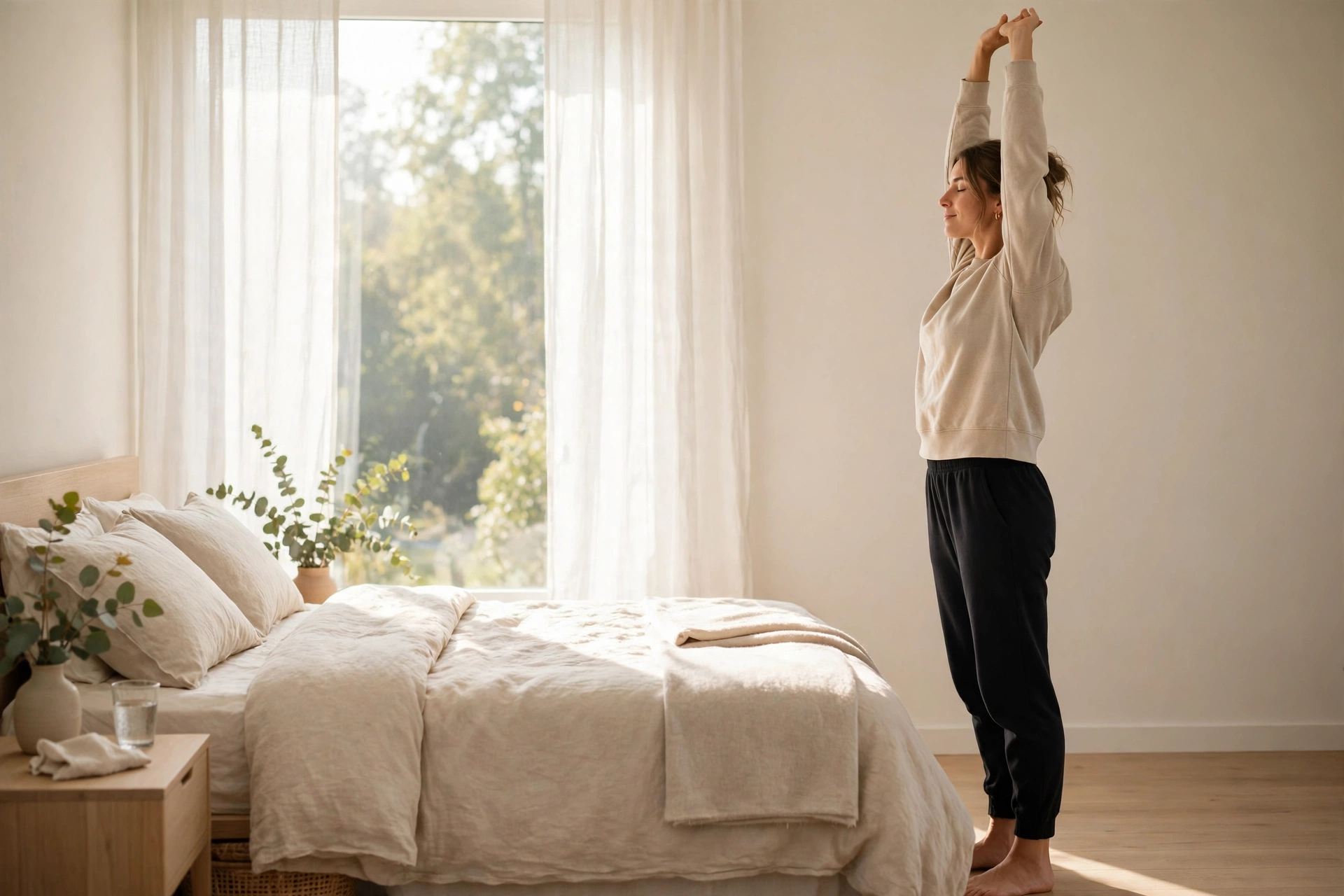
You wake up, swing your legs out of bed, and everything feels tight — your neck, your shoulders, your lower back. It is a normal part of mornings, especially if you slept in one position all night or spent the previous day sitting. A short stretch routine can loosen that stiffness before the day starts.
This routine is built for beginners: no equipment and no experience needed. Each move lasts about a minute, and the whole sequence adds up to ten minutes. Do it right after waking up, on the bedroom floor or a rug.
Why Stretch First Thing in the Morning
Overnight, your muscles spend hours mostly still. Blood flow slows, joints stiffen, and your body temperature drops slightly. Gentle stretching reverses that: it raises blood flow to the muscles, wakes up your joints, and signals your nervous system that the day has started.
Many people also find that a slow, deliberate morning routine sets a calmer tone for the day. Ten quiet minutes of breathing and moving beats scrolling through your phone while your coffee brews — and it pairs well with other small morning habits, like the better sleep habits that make waking up easier.
One honest note: stretching feels good and helps with stiffness, but it is not a treatment for pain or an injury. If a stretch hurts — sharp pain, not mild tension — stop that move. If you have an existing injury, back problem, or medical condition, check with a doctor or physiotherapist before starting any new routine.
Before You Start: 4 Simple Rules
- Breathe normally. Never hold your breath during a stretch. Slow, steady breathing helps muscles relax into the position.
- Move gently, never bounce. Ease into each stretch until you feel mild tension, then hold still. Bouncing can strain cold muscles.
- Mild tension is fine; pain is not. A stretch should feel like a pull, not a sting. Back off if it hurts.
- Keep it slow. This is not a workout. If a move feels rushed, you are going too fast.
The 10-Minute Routine
Here is the full sequence at a glance — nine moves, ten minutes total:
| Move | Time |
|---|---|
| 1. Neck and shoulder rolls | 1 minute |
| 2. Overhead reach and side bend | 1 minute |
| 3. Cat-cow | 1 minute |
| 4. Standing forward fold | 1 minute |
| 5. Low lunge | 2 minutes (1 per side) |
| 6. Seated hamstring stretch | 1 minute |
| 7. Seated spinal twist | 1 minute |
| 8. Child’s pose | 1 minute |
| 9. Deep breathing finish | 1 minute |
1. Neck and Shoulder Rolls (1 minute)
Stand tall with your arms relaxed. Roll your shoulders forward in big circles five times, then backward five times. Tilt your right ear toward your right shoulder and hold for ten seconds, feeling the stretch down the left side of your neck. Repeat on the other side, then finish with two slow neck circles in each direction.
2. Overhead Reach and Side Bend (1 minute)
Reach both arms overhead, interlace your fingers, and press your palms toward the ceiling. Hold for ten seconds, breathing deeply. Then lean gently to the right, keeping your arms overhead, and hold for ten seconds. Return to centre and lean left for ten seconds. Finish with one more straight overhead reach.
3. Cat-Cow (1 minute)
Come onto all fours, hands under shoulders and knees under hips. As you breathe in, drop your belly toward the floor and lift your head and tailbone — this is cow. As you breathe out, round your spine toward the ceiling and tuck your chin — this is cat. Move slowly between the two for about six full rounds.
4. Standing Forward Fold (1 minute)
Stand up, feet hip-width apart, knees slightly bent. Hinge forward from your hips and let your upper body hang toward the floor, arms dangling or holding opposite elbows. Let your head hang heavy. Hold for 30 seconds, then bend your knees a little more and rise slowly, one vertebra at a time.
5. Low Lunge (2 minutes — 1 minute per side)
Step your right foot forward into a deep lunge, left knee on the floor behind you, hands on your front knee or the floor. You should feel a stretch at the front of your left hip — the hip flexor, which tightens after hours of sitting or lying down. Hold for a full minute, breathing steadily. Switch sides and repeat.
6. Seated Hamstring Stretch (1 minute)
Sit on the floor with your right leg straight and your left foot against your right inner thigh. Sit tall, then hinge forward from your hips toward your right foot until you feel a gentle pull behind your thigh. Hold for 30 seconds. Switch legs and repeat. Keep your back straight rather than rounding it — the stretch should come from the hips, not from curling your spine.
7. Seated Spinal Twist (1 minute)
Sit cross-legged. Place your right hand on your left knee and your left hand behind you on the floor. Gently twist your torso to the left, looking over your left shoulder. Hold for 30 seconds, breathing into the twist. Switch sides and repeat.
8. Child’s Pose (1 minute)
Kneel on the floor, sit your hips back toward your heels, and reach your arms forward along the floor, forehead resting down. Breathe slowly into your lower back — you should feel it expand with each inhale. This is the most restful move in the routine, stretching the hips, thighs, and lower back all at once.
9. Deep Breathing Finish (1 minute)
Sit comfortably, cross-legged or in a chair. Close your eyes. Breathe in slowly through your nose for four counts, hold for two, and breathe out through your mouth for six counts. Repeat for a full minute. You are done — your body has had a proper start to the day.
How to Make It a Habit
A ten-minute routine only works if you actually do it, and the first week is the hardest part. Three things help:
- Attach it to something you already do. Stretch right after you brush your teeth or while the kettle boils. Linking a new habit to an existing one makes it automatic faster.
- Do it in the same spot every day. A rug by the bed is enough. Removing decisions removes excuses.
- Start with five minutes if ten feels like too much. Do the first five moves only, and add the rest once the habit sticks. A shorter routine you actually do beats a perfect one you skip — the same principle behind building an exercise habit you actually stick to: start small, stay consistent, and let the habit grow.
If you want more movement after stretching, a short walk is a natural next step — even a gentle one counts toward walking 10,000 steps a day.
Frequently Asked Questions
Can I do this stretching routine every morning?
Yes. Gentle daily stretching is safe for most healthy adults, and daily practice is how flexibility improves. If a move leaves you sore the next day, ease off it for a day and reintroduce it gently.
Should I stretch before or after breakfast?
Either works. Stretching on an empty stomach feels more comfortable for most people, but a light snack first is fine too — pick whatever fits your morning.
What if I am very stiff and cannot do some of these moves?
Modify them. In the forward fold, bend your knees as much as you need. In the low lunge, put a folded towel under your back knee. In child’s pose, widen your knees if your hips are tight. The right version of a stretch is the one you can hold comfortably for the full time.
Is morning stretching enough exercise for the day?
It is a good start, not a complete workout. Stretching improves flexibility and eases stiffness, but it does not build strength or much cardiovascular fitness. Think of it as the foundation: it makes the rest of your movement — walking, chores, workouts — easier and more comfortable.
Final Thoughts
Ten minutes is a small price for a morning that starts loose instead of stiff. You do not need special clothes, equipment, or experience — just a few minutes on the floor before the day pulls you in every direction. Try the routine for a week and notice how your mornings feel by day seven.