
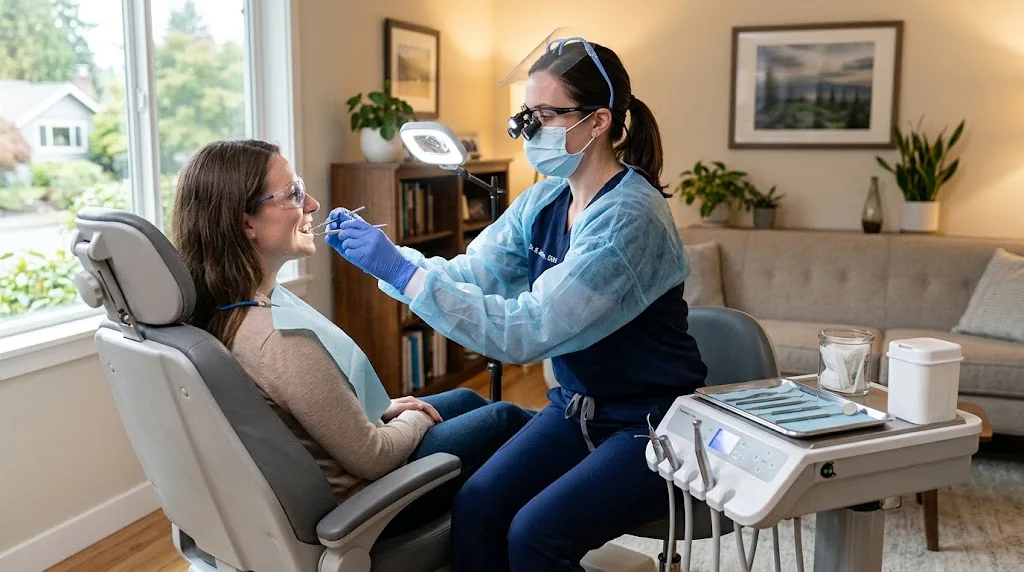
This guide explains what dental home services are, what patients should look for in reviews, the potential benefits and limitations, cost considerations, safety questions, and when traditional dental care may be more appropriate.
What Are Dental Home Services?
Dental home services are dental or oral-health services delivered at a patient’s residence rather than exclusively inside a conventional dental clinic. A mobile dental professional may travel to the patient’s home with portable equipment and supplies appropriate for the services being provided.
The exact scope of care varies considerably between providers. Some mobile services focus primarily on examinations, preventive care, oral-health education, and care for people with mobility or access challenges. Others may provide a broader range of treatment depending on their equipment, clinical setup, professional qualifications, and local requirements.
Patients should therefore avoid assuming that every company offering “dentist at home” services provides the same treatments. A review is most useful when it describes the actual service received rather than simply giving a general rating.
What Services Can a Dentist Provide at Home?
Home dental services vary by provider, but potential offerings may include:
- Routine oral examinations
- Preventive oral-health assessments
- Dental hygiene and cleaning services where appropriately equipped
- Oral-health education and personalized home-care guidance
- Follow-up care for existing dental treatment
- Care coordination with a traditional dental practice
- Tele-dentistry consultations where legally and clinically appropriate
- Selected services for older adults or patients with limited mobility
The availability of procedures depends on the clinician, patient’s condition, equipment, and local regulations. A home visit should not automatically be considered equivalent to a fully equipped dental office.
Benefits of Dental Home Services
Convenience
The most obvious advantage is that the patient does not necessarily need to travel to a dental office. This can be particularly helpful for people who have transportation difficulties, limited mobility, demanding schedules, or caregiving responsibilities.
Better Access for People With Mobility Challenges
Home-based dental care may be especially useful for older adults, people with disabilities, and patients who find traveling to a clinic difficult. Removing the transportation barrier can make it easier for some people to maintain regular oral-health care.
A Familiar Environment
Some patients experience dental anxiety in unfamiliar clinical environments. Receiving appropriate care at home may feel less stressful for certain individuals. However, comfort should never come at the expense of clinical safety or appropriate treatment.
Personalized Attention
A home visit may allow the dental professional to understand aspects of the patient’s daily environment and routine that are difficult to discuss during a short office appointment. This can be useful when developing practical home oral-care recommendations.
Reduced Travel and Waiting Time
For patients who spend significant time arranging transportation or waiting for appointments, a mobile service can simplify the logistics of receiving care.
What Do Dental Home Services Reviews Tell You?
Online reviews can help patients compare providers, but they should be evaluated carefully. A five-star rating alone does not establish that a provider is clinically appropriate for a particular patient.
When reading dental home service reviews, look for specific details about:
- The type of appointment the reviewer received
- Whether the provider arrived as scheduled
- Communication before and after the appointment
- The professionalism of the dental team
- Cleanliness and infection-control practices
- Whether the provider clearly explained treatment options
- Pricing and whether additional charges were disclosed
- How the provider handled referrals when home treatment was not appropriate
Reviews describing a specific experience are generally more informative than vague comments about customer service or convenience.
How to Evaluate the Quality of a Dental Home Service
Check the Dentist’s Credentials
Before booking an appointment, verify that the dental professional is appropriately licensed to practice in the relevant state. Patients should also determine who will actually provide the service rather than relying solely on the brand name of a mobile dental company.
Confirm Exactly What Is Included
Ask what the home visit covers before making an appointment. A service described as a dental assessment may not include cleaning, X-rays, restorative treatment, or other procedures.
Ask About Equipment
Appropriate equipment is important for safe and effective care. Ask whether the provider can perform the examination or treatment you need in a home setting and what happens if additional diagnostic equipment is required.
Ask About Infection Control
Dental instruments and equipment require appropriate cleaning, disinfection, sterilization, handling, and storage procedures. Patients should feel comfortable asking the provider how these processes are managed during mobile visits.
Understand the Referral Process
A reputable home dental provider should recognize when a patient’s condition requires treatment that cannot safely be performed in a home environment. Ask how the service handles referrals to dental offices, specialists, imaging facilities, or emergency care when necessary.
Dental Home Services vs. Traditional Dental Offices
Neither model is automatically better for every patient. The most appropriate setting depends on the type of care required.
| Factor | Dental Home Services | Traditional Dental Office |
|---|---|---|
| Travel | Minimal or no patient travel for eligible home visits | Patient normally travels to the practice |
| Convenience | Can be highly convenient for eligible patients | Depends on appointment availability and location |
| Mobility support | Can help patients who have difficulty traveling | May require transportation and accessibility arrangements |
| Equipment | Limited by portable equipment and the home environment | Usually has access to a broader range of clinical equipment |
| Complex procedures | May require referral elsewhere | More suitable for many complex procedures |
| Environment | Patient’s home | Purpose-built clinical environment |
How Much Do Dental Home Services Cost?
There is no single price for dental home services. The cost can vary according to the provider, location, type of appointment, travel distance, treatment required, equipment used, insurance arrangements, and whether additional care is needed.
A home visit may cost more than a comparable office appointment because the provider has additional travel, scheduling, and mobile-equipment expenses. However, some patients may consider the additional cost worthwhile when transportation, mobility, time, or accessibility are significant concerns.
Before booking, ask for a clear estimate and find out whether the quoted price includes the examination, travel, cleaning, diagnostic services, supplies, follow-up care, or other charges.
Questions to Ask About Price
- What is the total cost of the home visit?
- Is there a separate travel or mobile-service fee?
- Are diagnostic tests included?
- Will cleaning or other treatment cost extra?
- Does the provider accept dental insurance?
- Will the service submit insurance claims?
- What happens if I need treatment at a dental office afterward?
Are Dental Home Services Safe?
Dental care performed at home can be appropriate for selected patients and services when it is delivered by qualified professionals using suitable equipment and clinical procedures. However, the home setting can impose limitations that do not exist in a fully equipped dental practice.
Patients should not choose home treatment simply because it is more convenient. The provider should first determine whether the requested service is appropriate for the home environment.
For example, some conditions may require diagnostic imaging, specialized instruments, sedation capabilities, surgical facilities, or other resources that are not practical to bring into a patient’s residence.
When Home Dental Care May Not Be Enough
Home services may not be suitable for every dental problem. A patient may need to visit a traditional dental office or specialist when the condition requires equipment or procedures that cannot safely be provided at home.
Examples can include:
- Complex restorative procedures
- Many root canal treatments
- Dental implant procedures
- Complex oral surgery
- Procedures requiring extensive diagnostic imaging
- Treatments requiring specialized clinical equipment
- Conditions requiring sedation or surgical monitoring
The appropriate treatment setting should be determined by a qualified dental professional rather than by convenience alone.
Dental Home Care Is Still Important
Professional dental visits are only one part of maintaining oral health. Daily home care remains important between appointments.
The American Dental Association recommends brushing twice a day with fluoride toothpaste for two minutes and cleaning between the teeth daily. The ADA also recommends a healthy diet that limits sugary beverages and snacks and regular dental care tailored to individual needs.
The best interdental cleaning method can vary between individuals. Options can include traditional dental floss, interdental brushes, oral irrigators, or other devices. Patients who are unsure which method is appropriate should ask their dental professional for personalized guidance.
Be Careful With DIY and At-Home Dental Treatments
“At-home dental care” can mean two very different things: professional dental services delivered at home and unsupervised treatment products used without professional assessment.
These should not be confused.
Routine oral hygiene at home is an important part of prevention, but some treatments require professional examination and supervision. The American Dental Association specifically discourages do-it-yourself orthodontic treatment because improperly fitted appliances can cause injury, tooth movement problems, periodontal complications, and other harm.
Patients should therefore be cautious about products or services that promise to diagnose, straighten, repair, or significantly transform teeth without appropriate professional evaluation.
Who May Benefit Most From Dental Home Services?
Home dental services can be particularly useful for people who face practical barriers to traditional dental visits.
- Older adults with limited mobility
- People with physical disabilities
- Patients who have difficulty arranging transportation
- People receiving care at home for other reasons
- Patients who need selected follow-up or preventive services
- People who value the convenience of mobile healthcare
However, eligibility and available services differ between providers. A patient should discuss their individual needs with the dental professional before assuming a home visit is appropriate.
What to Look for Before Booking a Home Dentist
A short checklist can make the comparison process easier:
- Verify the dentist’s license and professional credentials.
- Confirm the exact service you need is available at home.
- Ask how the provider handles sterilization and infection control.
- Request the complete price before treatment.
- Ask whether dental insurance is accepted.
- Read detailed reviews rather than relying only on star ratings.
- Find out whether diagnostic imaging is available or arranged separately.
- Ask what happens if your condition requires treatment in a dental office.
- Confirm how follow-up appointments are handled.
Frequently Asked Questions
Can a dentist really treat patients at home?
Yes, some dental professionals provide mobile or home-based services. The treatments available depend on the provider, equipment, patient, and local requirements.
Are dental home services more expensive?
They can be, particularly when travel and mobile-service costs are included. The actual price varies by provider and treatment, so patients should request a complete estimate before booking.
Can I get a complete dental treatment at home?
Not necessarily. Some routine or preventive services may be possible at home, while complex procedures may require a conventional dental office or specialist facility.
Are online reviews enough to choose a home dentist?
No. Reviews can provide useful information about communication, convenience, and patient experience, but patients should also verify credentials, available services, pricing, and clinical procedures.
Is home oral care a replacement for seeing a dentist?
No. Daily brushing and interdental cleaning are important, but professional dental care remains an important part of preventing and managing oral disease. The American Dental Association recommends regular dental care based on individual needs.
Final Takeaway
Dental home services can provide a valuable alternative for patients who need greater convenience or face barriers to traveling to a dental office. Their biggest advantages are accessibility, reduced travel, and the ability to receive selected professional services in a familiar environment.
At the same time, home dental care has practical limitations. Not every procedure can be safely or effectively performed in a residence, and some patients will still need traditional dental appointments, diagnostic imaging, specialists, or emergency treatment.
The best approach is to evaluate dental home services based on clinical qualifications, the specific services offered, safety and infection-control practices, pricing transparency, detailed patient reviews, and the provider’s ability to coordinate additional care when necessary.
Important: This article is for general educational purposes and is not a diagnosis or substitute for professional dental advice. If you have severe dental pain, swelling, bleeding, trauma, fever, difficulty breathing or swallowing, or another urgent symptom, seek appropriate professional or emergency care.