
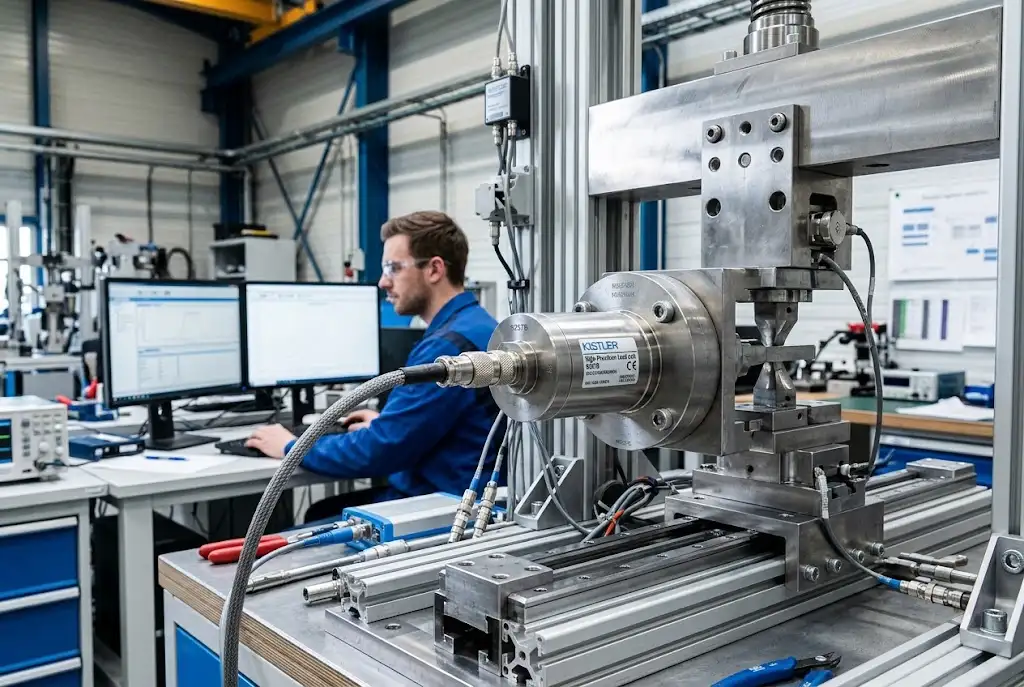
From product testing and manufacturing to robotics, medical technology, aerospace research, and automotive development, sensors can serve as the connection between a physical process and a digital measurement system. When that connection is accurate and reliable, engineers can make better decisions about design, quality, performance, and safety.
Futek’s sensor technology is therefore relevant to a broad range of precision applications where measurement quality matters. The company’s product portfolio includes load cells, force sensors, torque sensors, pressure sensors, and related measurement systems designed for demanding applications.
What Is Futek Advanced Sensor Technology?
Futek advanced sensor technology refers to sensor and measurement solutions developed for applications where forces, loads, torque, pressure, and related physical variables need to be measured accurately.
A sensor converts a physical condition into a measurable signal. In an industrial environment, that signal can then be collected, analyzed, displayed, or used by a control system.
This creates a valuable information loop:
- A physical force or condition occurs.
- The sensor detects the change.
- The measurement is converted into an electrical signal.
- Instrumentation or software processes the signal.
- Engineers or automated systems use the resulting data.
The quality of each stage matters. A measurement system that produces inconsistent or poorly understood data can affect testing, production decisions, quality control, and product development.
Why Precision Sensors Matter in Modern Engineering
Modern engineering increasingly depends on measurable evidence. Instead of relying exclusively on visual inspection or assumptions, engineers can use sensor data to understand how a component, machine, or product behaves under specific conditions.
Precision sensors can help answer questions such as:
- How much force is being applied?
- How does torque change during operation?
- What load is a component experiencing?
- How does a system behave under different test conditions?
- Is a manufacturing process remaining within its required parameters?
- Has a mechanical system changed over time?
These measurements can support engineering validation, quality assurance, research, automation, and maintenance decisions.
Futek Load Cells and Force Measurement
Load cells are among the most important tools for measuring force or weight in engineering and industrial applications. A load cell responds to an applied load and produces a measurable output that can be interpreted by compatible instrumentation.
Load-cell technology can be used in applications ranging from laboratory testing to industrial machinery and product-development systems.
For engineers, the appropriate load cell depends on factors such as:
- Required capacity
- Measurement accuracy
- Environmental conditions
- Physical installation space
- Loading direction
- Expected operating cycles
- Required output and instrumentation
Selecting a sensor should therefore begin with the measurement requirement rather than simply choosing a sensor based on its size or headline specification.
Torque Sensors for Rotational Applications
Torque measurement is essential when engineers need to understand rotational force. Applications can include motors, drivetrains, test benches, robotics, power transmission systems, and other mechanical assemblies.
A torque sensor can provide information about how much rotational force is being applied and how that force changes during operation.
This data can be valuable during product development because engineers can compare expected performance with measured performance.
In an automotive or industrial test environment, for example, torque measurements can help teams evaluate drivetrain behavior, motor performance, component durability, or changes introduced during design iterations.
Pressure Measurement and System Monitoring
Pressure measurement is another important part of engineering instrumentation. Fluid and pneumatic systems can depend on accurate pressure information to verify operating conditions and identify changes.
Pressure sensors may be used in test equipment, industrial systems, laboratory environments, and specialized engineering applications.
As with force and torque measurement, the correct pressure sensor depends on the application’s range, environment, connection requirements, response characteristics, and measurement objectives.
High-Precision Measurement in Manufacturing
Manufacturing environments depend on repeatability. A process that produces slightly different results from one production cycle to the next can create quality problems, material waste, or additional inspection requirements.
Sensor-based measurement can help manufacturers monitor important process variables and identify deviations earlier.
For example, force or torque measurement can be integrated into assembly processes to verify that components are being installed within defined parameters.
This can be particularly useful when manual inspection would be difficult, inconsistent, or too slow for production volumes.
Organizations interested in the broader role of technology in production can also explore digital manufacturing operating procedures as part of a wider technology and manufacturing discussion.
Applications in Aerospace Engineering
Aerospace engineering places significant demands on measurement and testing because components and systems may need to operate under challenging conditions.
Force, torque, and load measurements can support structural testing, component evaluation, propulsion research, actuator testing, and other engineering activities.
The value of a sensor in such environments comes from its ability to produce dependable measurement data under the conditions for which it was designed.
Engineering teams can use that information to validate designs, evaluate components, and compare actual performance against expected behavior.
Automotive Testing and Development
Automotive engineering provides another strong use case for precision sensors. Modern vehicles contain complex mechanical, electronic, and control systems that require extensive testing during development.
Torque sensors can support drivetrain and motor testing, while force sensors can be used for component evaluation, actuator testing, and other measurement applications.
As vehicle technology continues to evolve, measurement systems also become increasingly important. This is especially relevant as electric vehicles introduce different motor, battery, thermal, and drivetrain architectures.
For broader context on changing automotive technology, readers can explore how electric vehicles are shaping urban transportation.
Medical Device Development
Medical-device engineering can require highly controlled testing because small differences in force, pressure, movement, or mechanical behavior may influence product performance.
Precision measurement can be incorporated into testing systems for devices, instruments, prosthetic technologies, and other engineered medical products.
In these environments, sensor selection should be based on the exact measurement requirement and applicable testing methodology. Engineers must consider accuracy, repeatability, environmental conditions, calibration, integration, and data collection.
Robotics and Automation
Robotics is another field where sensing and measurement are fundamental. Robots need information about their physical environment and mechanical behavior to perform tasks accurately.
Force and torque sensors can support applications involving assembly, manipulation, testing, and controlled interaction with objects.
For example, a robotic system performing a delicate assembly task may need to detect whether the applied force is within an acceptable range. Sensor feedback can allow the system to respond rather than operating entirely without measurement.
This relationship between sensors, software, and automation illustrates how physical measurement increasingly connects with digital technology.
Laboratory Research and Product Testing
Laboratories often require controlled measurements that can be repeated across experiments. Sensor accuracy and consistency can therefore influence the quality of research data.
Researchers may use force, load, torque, or pressure measurement to test materials, mechanical components, prototypes, instruments, and other systems.
Good experimental design also requires understanding what the sensor is actually measuring, how it is installed, and whether the measurement system has been appropriately calibrated.
Sensor Integration Into Existing Systems
Installing a sensor is only one part of building a measurement system. Engineers also need to consider signal conditioning, instrumentation, data acquisition, software, mechanical mounting, communication interfaces, and calibration.
A successful integration process should answer several questions:
- Where will the sensor be mounted?
- What physical variable needs to be measured?
- What measurement range is required?
- How will the output be collected?
- What instrumentation will process the signal?
- How will calibration be verified?
- How will the resulting data be stored and analyzed?
Planning these factors before installation can reduce integration problems and improve measurement reliability.
Calibration Is Essential for Measurement Confidence
Even a high-quality sensor needs appropriate calibration and verification. Calibration establishes a relationship between the sensor’s output and a known reference condition.
Calibration practices depend on the sensor type, application, measurement requirements, and applicable procedures.
Organizations should maintain appropriate documentation so engineers know when a sensor was calibrated, under what conditions, and what results were obtained.
Calibration records can become particularly important in regulated, research, quality-controlled, or safety-sensitive environments.
Accuracy, Repeatability, and Resolution Are Different
Technical discussions about sensors often use terms such as accuracy, repeatability, and resolution interchangeably, but they describe different aspects of measurement performance.
Accuracy
Accuracy concerns how closely a measurement corresponds to the true or accepted reference value.
Repeatability
Repeatability concerns how consistently a sensor produces similar results when the same measurement is repeated under the same conditions.
Resolution
Resolution describes the smallest change in the measured variable that the measurement system can distinguish.
Understanding these differences helps engineers select sensors based on the actual requirements of an application rather than focusing on a single specification.
Environmental Conditions Can Affect Sensor Performance
Industrial and laboratory environments are not always ideal. Temperature changes, vibration, humidity, electrical interference, mechanical shock, and other environmental factors can affect measurement systems.
Engineers should therefore evaluate the environment in which a sensor will operate before selecting a product.
Important considerations can include:
- Operating temperature
- Mechanical vibration
- Shock loads
- Moisture exposure
- Corrosive environments
- Electrical noise
- Installation constraints
- Expected measurement cycles
A sensor that performs well in a controlled laboratory may require different specifications when installed on a production floor.
Digital Data Makes Sensor Measurements More Useful
The value of sensor technology increasingly extends beyond the physical measurement itself. Digital data can be collected, visualized, compared, and analyzed to support broader engineering decisions.
When measurements are integrated with software and automated systems, teams can monitor trends rather than examining isolated readings.
This can support:
- Process monitoring
- Quality assurance
- Performance analysis
- Predictive maintenance
- Prototype validation
- Production optimization
- Engineering research
The wider technology ecosystem surrounding connected measurement is also changing rapidly. Readers interested in technology-driven business solutions can explore technology-driven business solutions and technology for business efficiency.
How Sensors Support Data-Driven Decision-Making
Reliable measurements allow engineers and managers to replace assumptions with evidence. Instead of asking whether a machine appears to be performing correctly, a team can examine measured data.
This supports a more structured decision-making process:
- Define the variable that needs to be measured.
- Select an appropriate sensing technology.
- Install and calibrate the sensor correctly.
- Collect measurements under controlled conditions.
- Analyze the resulting data.
- Compare performance against specifications or baselines.
- Use the findings to improve the process or product.
This approach can help organizations identify trends before they become major problems.
Quality Control and Process Improvement
Quality control is another area where measurement technology can deliver practical value. If a manufacturing process depends on a specific force, torque, or pressure range, sensors can help verify whether production remains within the intended limits.
Measurement data can also help identify process variation. When engineers can see when a parameter begins moving away from its expected range, they have an opportunity to investigate before large quantities of products are affected.
This is one reason sensor technology can be valuable as part of a broader digital manufacturing strategy.
Sensor Technology and Predictive Maintenance
Maintenance strategies are also becoming increasingly data-driven. Rather than relying exclusively on fixed service intervals, organizations can monitor equipment behavior and look for changes that may indicate developing problems.
Sensor measurements can contribute to this process by providing information about mechanical loads, torque, pressure, vibration, temperature, or other relevant variables.
Predictive maintenance should not be treated as simply installing sensors everywhere. The useful approach is to identify which measurements actually provide meaningful information about equipment condition.
Choosing the Right Futek Sensor
Selecting a sensor begins with defining the measurement problem. Before choosing a product, engineers should identify the variable being measured, expected range, accuracy requirements, environmental conditions, installation method, output requirements, and data-collection system.
A practical selection checklist includes:
- What physical variable needs to be measured?
- What is the expected measurement range?
- What level of accuracy is required?
- What environmental conditions will the sensor encounter?
- How will the sensor be mounted?
- How frequently will measurements be taken?
- What signal or interface does the system require?
- What calibration process will be used?
- What documentation is required?
- How will measurement data be analyzed?
Answering these questions can make the sensor-selection process much more precise.
Futek and the Broader Industrial Technology Landscape
Precision sensing does not operate independently from other technologies. Sensors increasingly form part of larger systems involving automation, software, robotics, digital manufacturing, and data analysis.
For example, a force sensor may provide the measurement, a data-acquisition system may collect the signal, software may visualize the result, and an automated control system may use the information to modify a process.
This interconnected model is one reason industrial technology continues moving toward more measurable and data-driven operations.
PostTrek also covers related technology topics, including modern technology solutions, technology-driven business innovation, and technology developments and analysis.
Why Engineering Teams Should Focus on Measurement Quality
A measurement is only useful when decision-makers can trust what it represents. Poorly selected sensors, incorrect installation, inadequate calibration, or unsuitable environmental specifications can all undermine the value of collected data.
For that reason, measurement quality should be considered at the beginning of an engineering project rather than treated as an afterthought.
Teams should define measurement objectives early, document requirements, select suitable instrumentation, establish calibration procedures, and determine how the resulting data will be interpreted.
Technology Trends Increasing the Importance of Sensors
Several technology trends are making sensing increasingly important across engineering and manufacturing.
Industrial Automation
Automated systems require reliable information about physical processes. Sensors provide the data that allows automated equipment to monitor and respond to changing conditions.
Connected Equipment
Connected industrial equipment can collect and transmit measurements for centralized monitoring and analysis.
Robotics
Robotic systems increasingly depend on force, torque, position, and other measurements to perform precise tasks.
Electric Mobility
Electric vehicles and related technologies introduce new testing requirements for motors, drivetrains, battery systems, and manufacturing processes.
Digital Manufacturing
Digital manufacturing depends on combining physical processes with digital information, making reliable measurement an important part of the overall architecture.
For another perspective on emerging technology and mobility, see innovative connected devices and technology.
What Makes a Sensor Technology Strategy Effective?
An effective sensing strategy is not defined by the number of sensors installed. It is defined by whether the measurements answer meaningful questions.
A strong strategy typically includes:
- Clearly defined measurement objectives
- Appropriate sensor selection
- Correct mechanical installation
- Suitable signal conditioning
- Reliable data acquisition
- Documented calibration
- Environmental consideration
- Consistent maintenance
- Useful data analysis
- Clear engineering actions based on results
This approach allows organizations to turn sensor hardware into a practical measurement system rather than treating the sensor as an isolated component.
Where Futek Advanced Sensor Technology Fits
Futek’s sensor solutions fit into a measurement ecosystem where accurate physical data supports engineering, manufacturing, research, testing, and automation.
The technology is particularly relevant when teams need to measure force, load, torque, or pressure and then use that information for product development, quality assurance, process monitoring, or system evaluation.
Rather than viewing sensors simply as pieces of hardware, organizations can consider them part of the information infrastructure behind modern engineering.
Final Thoughts
Futek advanced sensor technology illustrates the growing importance of precision measurement in modern engineering. From force and load measurement to torque and pressure applications, sensors can transform physical behavior into useful data that engineers and organizations can analyze.
The strongest results come when sensor selection, installation, calibration, environmental requirements, data acquisition, and analysis are considered together.
As manufacturing, robotics, automotive development, aerospace engineering, medical-device testing, and industrial automation become increasingly data-driven, reliable measurement will remain a fundamental part of technical decision-making.
For organizations evaluating sensor solutions, the most important starting point is not simply choosing advanced hardware. It is defining exactly what needs to be measured, why the measurement matters, and how the resulting data will be used.
For product information, technical documentation, and current sensor offerings, readers should consult Futek’s official website directly.