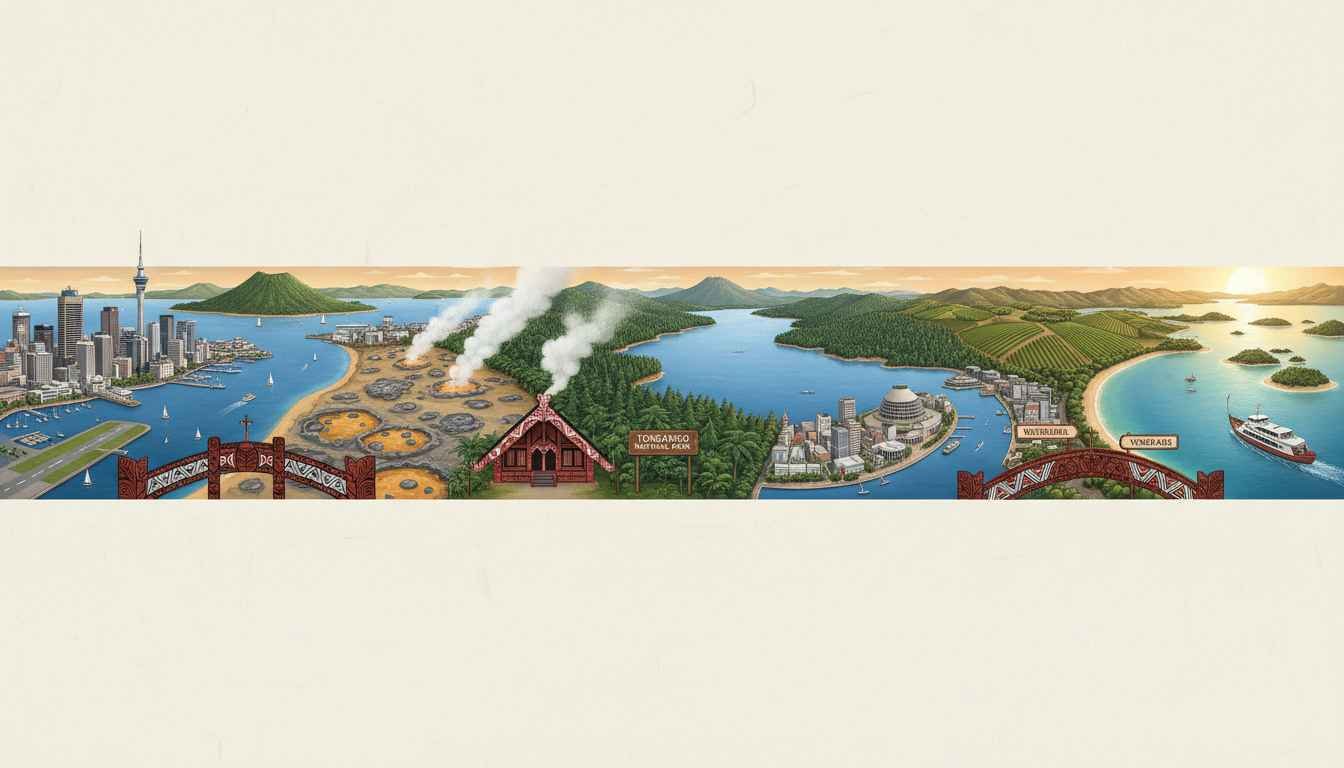
New Zealand’s North Island packs an unusual amount of variety into one island: a harbour city, steaming geothermal valleys, Māori cultural centres, surf beaches and quiet wine country. Most of the country’s population lives here, and the distances between highlights are short enough that a single trip can cover cities, nature and culture without rushing. Here are the places that make the North Island worth the journey.
Auckland and Waiheke Island
Auckland is the natural starting point. New Zealand’s largest city sits between two harbours, the Waitematā and the Manukau, and its volcanic cones — including Mount Eden and One Tree Hill — give easy viewpoints over the water and the skyline. The waterfront around Viaduct Harbour and the Auckland Art Gallery are good first-day stops, and the Auckland Museum gives a solid introduction to Māori history and Pacific culture.
A short ferry ride from downtown takes you to Waiheke Island, known for its vineyards, olive groves, beaches and walking trails. It works well as a day trip, but staying a night lets you enjoy the island’s restaurants and slower pace. If you are planning a wider Pacific itinerary, it is worth comparing notes with other island-hopping routes, such as the best places to visit between Brisbane and Sydney, which follows a similar mix of city stops and coastal scenery.
Bay of Islands
North of Auckland, the Bay of Islands is one of the country’s most historic regions. The town of Russell was one of New Zealand’s first European settlements, and nearby Waitangi is where the Treaty of Waitangi was signed in 1840. Today the area is better known for sailing, dolphin watching and relaxed coastal towns such as Paihia and Kerikeri. The sheltered waters make it a good choice for travellers who want scenery without strenuous hiking.
Rotorua and the Geothermal Heartland
Rotorua is the North Island’s geothermal showpiece. Geysers, bubbling mud pools and steaming lakes shape the landscape around the city, and the Whakarewarewa valley is one of the best places to see this activity up close. Rotorua is also a centre of Māori culture, with guided village visits, traditional performances and carving and weaving demonstrations that explain the living culture rather than just displaying it.
South of Rotorua, Lake Taupō fills the caldera of a supervolcano that erupted nearly 2,000 years ago. The lake town is a base for trout fishing, kayaking and lakeside walks, and the Huka Falls nearby are an easy stop on the way south.
Waitomo and the Waikato
The Waitomo Caves, west of Rotorua, are famous for their glowworm grotto, where thousands of tiny lights reflect on underground water. Boat tours through the caves are short and suitable for most fitness levels, and the surrounding limestone country has walking tracks and farm scenery. Nearby Matamata is home to the Hobbiton film set, a popular stop for fans of The Lord of the Rings and The Hobbit films.
Coromandel Peninsula
East of Auckland, the Coromandel Peninsula is a favourite weekend escape for New Zealanders themselves. Cathedral Cove, reached by a coastal walking track, is the best-known sight, while Hot Water Beach lets visitors dig their own hot pools in the sand at low tide. The peninsula’s kauri forests and small beach towns give a quieter contrast to the cities further south, and it pairs well with a Rotorua loop for a week-long North Island circuit.
Wellington, the Capital at the Southern Tip
Wellington sits at the island’s southern end, a compact, walkable city wrapped around a harbour. Te Papa Tongarewa, the national museum, is the standout attraction: free to enter, with exhibitions on natural history, Māori culture and New Zealand’s national story. The cable car up to the Botanic Garden gives a classic view over the city, and the Cuba Street precinct is the place for cafés and independent shops.
From Wellington, the Wairarapa region to the east offers vineyards around Martinborough and quiet coastal towns, a good contrast to the capital’s energy. Wellington is also the departure point for the Interislander ferry across Cook Strait to the South Island, if your trip continues south.
Planning Tips for the North Island
A rental car gives the most freedom, especially for Rotorua, Waitomo and the Coromandel Peninsula, where public transport is limited. If you prefer not to drive, intercity buses connect the main centres, and Auckland, Rotorua and Wellington all have domestic airports. Spring and autumn generally bring mild temperatures and fewer crowds than the summer peak, which suits walking, cycling and sightseeing. Book popular attractions such as Hobbiton and Te Puia in advance during school holidays.
FAQ: Visiting the North Island
How many days do I need for the North Island?
Ten to fourteen days covers Auckland, Rotorua, Waitomo and Wellington at a comfortable pace. With only a week, focus on Auckland, Rotorua and one other region rather than trying to see everything.
Is the North Island suitable for families?
Yes. The island has museums, beaches, wildlife parks and geothermal attractions that suit a wide range of ages, and driving distances between major stops are manageable for children.
Do I need a car?
A car is the most flexible option outside the main cities. Buses and domestic flights work for city-to-city travel, but rural highlights such as the Coromandel and Waitomo are much easier with your own transport.
What is the best time to visit?
Spring (September to November) and autumn (March to May) offer mild weather, lower prices and fewer crowds. Summer is warmest but busiest, while winter is quiet and good for geothermal bathing and museum visits.
From volcanic cities to steaming valleys and harbour towns, the North Island rewards travellers who mix its natural wonders with its cultural stops. Plan around a few key bases, leave room for unplanned detours, and the island’s variety will do the rest.