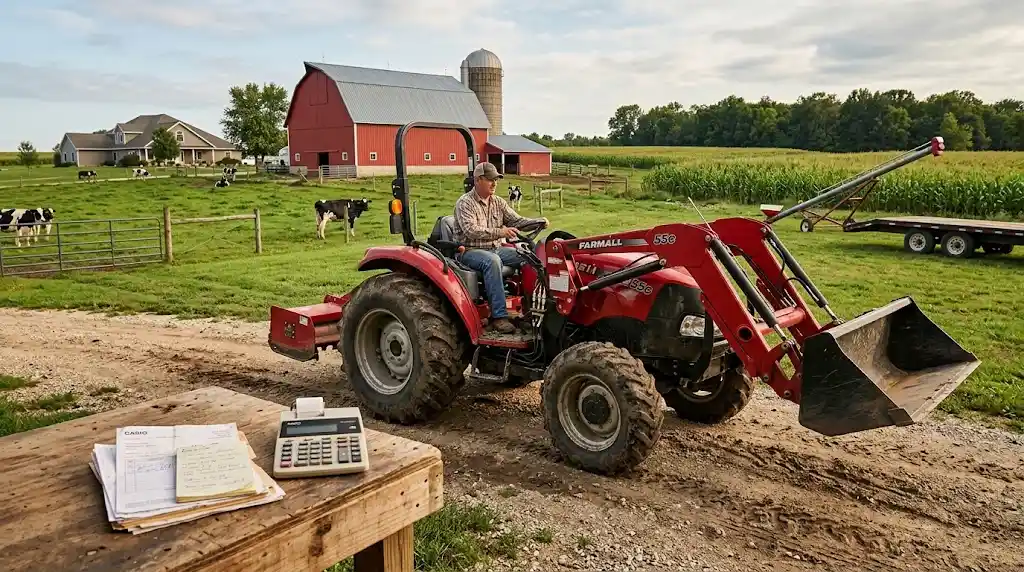
Rural King tractor financing can make the cost of purchasing farm and property equipment easier to manage by spreading payments over time rather than requiring the full purchase price upfront. Rural King’s current RK Tractor materials show financing options on new tractors, with terms, APRs, payment amounts, and qualification requirements varying by model and borrower.
What Is Rural King Tractor Financing?
Rural King tractor financing refers to financing options available for eligible tractor purchases through Rural King and its financing arrangements. The company sells RK Tractors ranging from compact machines designed for property and light agricultural work to larger utility tractors.
Rural King’s current tractor information says financing is available and directs customers to their local Rural King store for details. The company also states that zero-down financing can be available for qualifying tractor purchases, with financing terms extending up to 84 months.
The exact financing structure should always be confirmed before signing a purchase agreement because a promotional payment example is not necessarily the same as the offer available to every buyer.
Why Farmers Consider Tractor Financing
A tractor is often a major equipment purchase. Paying the entire cost upfront can place significant pressure on a farm’s working capital, especially when the tractor is being purchased alongside implements, attachments, insurance, maintenance supplies, and other operating expenses.
Financing can spread the acquisition cost across scheduled payments. This may allow a farmer or property owner to preserve some cash for seasonal expenses or other productive uses.
However, financing should be evaluated as part of the farm’s overall cash-flow plan rather than simply by looking at the monthly payment.
Current Rural King Tractor Financing Examples
Current RK Tractor materials provide useful examples of how financing can vary between models.
RK24H Financing Example
The RK24H is a 24-horsepower hydrostatic tractor. Current pricing lists the tractor with a quick-attach loader at $16,999, with an example monthly payment of $232.31 based on an 84-month loan at 3.99% fixed APR and no down payment.
The actual payment can be higher once taxes, insurance, accessories, attachments, delivery, or other applicable costs are included.
RK55S Financing Example
The RK55S is a 55-horsepower shuttle-shift utility tractor. Current pricing lists the model with a quick-attach loader at $32,999, with an example payment of $450.97 per month based on an 84-month loan at 3.99% fixed APR.
The difference between the RK24H and RK55S illustrates why equipment selection should come before financing decisions. A lower monthly payment is not necessarily better if the tractor lacks the power or hydraulic capability needed for the intended work.
Does Rural King Offer 0% Tractor Financing?
Rural King has advertised promotional financing as low as 0% APR on qualifying new tractors. Current 2026 RK Tractor promotional material states that qualified buyers may receive financing as low as 0% APR, subject to specific terms and conditions.
Importantly, “as low as 0% APR” does not mean every buyer automatically receives 0% financing. The promotional material states that APR can depend on credit score and qualification, and that the available term may be limited to specific promotional periods.
For this reason, shoppers should compare the actual financing offer they receive rather than assuming that a promotional rate applies to their purchase.
How Long Can You Finance a Rural King Tractor?
Rural King’s RK Tractor information states that financing can extend for up to 84 months. Current model examples demonstrate how longer terms can reduce the scheduled monthly payment while increasing the length of the repayment period.
A longer loan term may improve monthly cash flow, but it can also mean that the buyer remains obligated for a longer period. Compare the total amount paid over the entire loan rather than focusing only on the monthly figure.
Can You Finance a Tractor With No Down Payment?
Rural King states that zero-down financing can be available for qualifying purchases. Some current payment examples are based on no down payment.
Zero-down financing can reduce the amount of cash needed at the time of purchase, but it also means the buyer finances more of the equipment cost. Depending on the APR and loan term, that can affect the total financing cost.
A buyer should therefore compare both scenarios: making a down payment and financing the full eligible amount.
What Determines Your Tractor Financing Rate?
The financing rate offered to a tractor buyer can depend on several factors.
- Credit history
- Credit score
- Loan amount
- Loan term
- Equipment being financed
- Collateral requirements
- Promotional financing availability
- Current lender terms
- Applicant qualifications
Rural King’s current financing disclosures specifically state that APR, fees, terms, and conditions may vary according to creditworthiness, qualifications, and collateral conditions, and that all loans are subject to approval.
What Credit Score Do You Need?
There is not a single publicly stated credit-score threshold that guarantees Rural King tractor financing approval for every buyer.
Instead of relying on an online claim that a particular score automatically qualifies, applicants should speak with the financing provider or their local Rural King store and ask what documentation and qualification standards apply to their specific purchase.
A stronger credit profile may improve the chances of receiving favorable financing terms, but approval and APR can depend on more than a credit score alone.
What Documents May Be Needed?
The exact documentation depends on the financing arrangement and applicant. A lender may request information needed to verify identity, income, creditworthiness, business activity, or other aspects of the application.
Farm operators should have basic financial information available before applying, including a realistic estimate of household or farm cash flow and the amount they can comfortably allocate toward equipment payments.
Having this information ready can make it easier to compare financing options and avoid purchasing equipment that creates excessive financial pressure.
Can Tractor Attachments Be Financed?
Attachments can represent a significant portion of the total cost of a tractor setup. Rural King offers performance-matched implements and attachments for RK Tractor models, and its company information states that associated transport trailers and hitch equipment can also be included in financing with a tractor purchase in qualifying situations.
Depending on the equipment package, common attachments may include:
- Front loaders
- Backhoes
- Rotary cutters
- Tillers
- Rear blades
- Box blades
- Grapples
- Landscape rakes
Before financing a package, calculate the cost of the complete setup rather than evaluating only the base tractor.
How to Choose the Right RK Tractor Before Financing
The most important financing decision may actually happen before you submit the application: choosing the correct tractor.
A machine that is too small may struggle with demanding jobs and require additional equipment later. A tractor that is substantially larger than necessary may increase the purchase price, operating expenses, and financing obligation without delivering enough additional value for your property.
For Smaller Properties
A compact or subcompact tractor may be suitable for mowing, landscaping, material handling, light grading, driveway maintenance, and similar property-management tasks.
For General Farm Work
A larger compact or utility tractor may make more sense when the work involves heavier implements, greater lifting capacity, field work, or more demanding ground conditions.
For Commercial or Heavy-Duty Applications
Higher-horsepower equipment may be appropriate when the tractor will be used intensively with large implements or demanding agricultural applications.
RK24 Series: A Compact Financing Option
The RK24 series illustrates the type of equipment aimed at smaller property owners and users who need a compact tractor without moving into a larger utility class.
The RK24H uses a 24-horsepower diesel engine and hydrostatic transmission. Rural King describes the model as suitable for jobs around farms and yards and offers compatible attachments such as loaders and backhoes.
For buyers primarily interested in property maintenance, landscaping, light agricultural tasks, or smaller acreage, a compact tractor can provide a more appropriate starting point than a larger machine.
RK55 Series: More Power for Demanding Work
The RK55 series moves into a larger utility-tractor category. Current specifications identify the RK55S as a 55-horsepower model with a synchronized shuttle-shift transmission.
Other RK55 variants are available with hydrostatic transmissions and cab configurations. The series is designed for buyers who need considerably more capability than a small compact tractor provides.
The increased purchase price means financing becomes particularly important. Buyers should calculate whether the additional capability will produce enough practical value to justify the larger financial obligation.
Rural King Tractor Financing vs. Paying Cash
Paying cash eliminates interest charges when no financing is used, but it also ties up capital that could potentially be used elsewhere in the farm or business.
Financing preserves more cash at the beginning of the purchase but creates a recurring payment obligation and potentially increases the total cost of ownership.
Neither option is automatically better. The right decision depends on the financing rate, available cash, farm cash flow, expected equipment utilization, tax considerations, and alternative uses for the money.
How to Calculate the Real Cost of a Financed Tractor
Do not stop at the advertised monthly payment. Build a complete equipment budget that includes:
- Tractor purchase price
- Down payment
- APR
- Loan term
- Taxes
- Insurance
- Delivery charges
- Attachments
- Maintenance
- Fuel
- Potential repair costs
This provides a more realistic picture of what the tractor will cost over the life of the financing arrangement.
Why the Monthly Payment Can Be Misleading
A longer financing term can make a tractor appear affordable because the monthly payment is smaller. However, the lower monthly figure does not necessarily mean the equipment is cheaper.
For example, spreading a purchase over seven years produces a much lower scheduled payment than paying it over three or four years. The buyer must consider the total financing cost and how long the tractor will remain under the loan.
The ideal payment should be one that fits comfortably within the farm’s normal cash flow without depending on optimistic assumptions about future revenue.
Can You Finance Used Tractors?
Financing availability can differ between new and used equipment. Rural King’s current promotional materials focus heavily on new RK Tractor financing, while its product information also references new or used tractor equipment in certain contexts.
Because used-equipment financing can depend on the tractor’s age, condition, value, lender policies, and purchase arrangement, buyers should confirm eligibility directly before assuming a used tractor qualifies for the same promotional terms as a new machine.
What About Tractor Financing for Poor Credit?
Applicants with weaker credit may face higher APRs, different terms, additional requirements, or difficulty qualifying for promotional financing.
Rather than applying based on an assumption that financing is guaranteed, buyers should compare their available options and determine whether the resulting payment is genuinely affordable.
It may also be worth improving the credit profile or saving for a larger down payment before purchasing, particularly when the higher financing cost would materially increase the total price of the tractor.
Rural King Financing and Farm Cash Flow
Farm income can be seasonal, so equipment financing should be evaluated against the timing of expected revenue rather than simply a monthly household budget.
A farmer should consider whether payments will still be manageable during periods of lower production or seasonal income. Maintaining a cash reserve can be particularly important because tractors are productive assets but also require fuel, maintenance, repairs, and insurance.
This is one reason a slightly less expensive tractor with the right capabilities can sometimes be financially preferable to purchasing the largest machine available.
Financing a Tractor for Landscaping or Property Maintenance
Not every tractor buyer is a commercial farmer. Property owners may use compact tractors for mowing large areas, maintaining gravel driveways, moving materials, clearing brush, grading land, or managing acreage.
For these buyers, financing should be based on expected usage. If a tractor will only be used a few times each year, renting equipment or hiring a local operator may be more economical.
On the other hand, owners who regularly maintain substantial acreage may find that owning the right compact tractor provides enough utility to justify the purchase.
Tractor Delivery and Additional Costs
Rural King states that tractor delivery is available for a fee based on distance. It also notes that transport trailers and associated hitch equipment may be included in financing with a tractor purchase in qualifying circumstances.
These costs should be included when calculating the total project budget. A tractor purchase does not end when the financing paperwork is signed; getting the equipment home and properly insured can also add to the initial expense.
Warranty and Long-Term Ownership
Rural King currently states that its 19–55 horsepower tractors have a two-year full-machine warranty and an eight-year, 3,000-hour powertrain warranty, while its 74-horsepower tractors have a two-year full-machine and five-year, 3,000-hour powertrain warranty.
Warranty coverage can be an important consideration when comparing equipment because a tractor is a long-term capital purchase. Buyers should review the current warranty documentation and understand what is and is not covered before purchasing.
Questions to Ask Before Signing a Financing Agreement
Before committing to Rural King tractor financing, ask the dealer or financing provider:
- What APR am I actually being offered?
- Is the APR promotional or standard?
- How long is the financing term?
- What is the total amount I will repay?
- Is a down payment required?
- Are taxes included in the payment?
- Is insurance required?
- Are attachments included in the financing?
- Are there processing or loan fees?
- What happens if I pay the loan early?
- What warranty applies to the tractor?
- Who services the equipment after purchase?
Rural King Tractor Financing: Pros and Cons
Potential Advantages
- Can reduce the upfront cash requirement.
- May provide promotional APR opportunities for qualifying buyers.
- Longer terms can reduce monthly payment amounts.
- Zero-down options may be available for qualified purchases.
- Eligible equipment packages may be financed together.
- Financing can preserve cash for farm operating expenses.
Potential Drawbacks
- Approval is not guaranteed.
- Not every buyer receives the lowest advertised APR.
- Longer terms can increase the total repayment period.
- Taxes and insurance can increase the effective cost.
- Attachments and delivery may add substantially to the purchase price.
- Equipment can depreciate while the financing obligation remains.
Alternatives to Rural King Tractor Financing
Rural King financing is not the only way to acquire farm equipment. Depending on the buyer and purchase, alternatives may include a bank agricultural loan, equipment financing from another lender, a manufacturer promotion, leasing, paying cash, or purchasing a lower-cost used machine.
For comparison, PostTrek also covers other financing topics, including utility trailer financing and consumer financing considerations.
These alternatives should not be assumed to have the same terms as tractor financing. Their purpose is simply to illustrate why comparing financing structures can be useful before making a large purchase.
How to Make Tractor Financing More Affordable
Choose the Right Size
Buying only the horsepower and attachments you actually need can reduce both the purchase price and financing obligation.
Compare Loan Terms
Compare the monthly payment with the total amount repaid. A lower monthly payment may come with a longer repayment period.
Consider a Down Payment
If cash reserves allow, a down payment can reduce the amount financed. However, do not drain the farm’s emergency or operating reserve simply to reduce the loan balance.
Compare Promotional Rates
Low- or zero-interest promotions can be valuable when available and when the buyer qualifies. Read the complete terms rather than focusing only on the headline APR.
Calculate Equipment Utilization
Estimate how many hours per year the tractor will actually work. High utilization can make equipment ownership easier to justify than occasional use.
Final Thoughts on Rural King Tractor Financing
Rural King tractor financing can provide a practical way to spread the cost of an RK Tractor over time, particularly when a buyer qualifies for competitive promotional terms. Current 2026 examples show financing structures ranging from compact RK24 equipment to larger RK55 utility tractors, with payment amounts determined by the equipment price, APR, term, and financing conditions.
The most important point is that the advertised monthly payment should be treated as an example rather than a guarantee. Rural King and its financing partner state that rates, terms, fees, taxes, insurance requirements, and approval conditions can vary.
Before buying, determine which tractor and attachments your property actually requires, calculate the complete ownership cost, compare the financing term and APR, and make sure the payment remains manageable under realistic farm cash-flow conditions.
For many buyers, the best financing decision is not simply the one with the lowest monthly payment. It is the financing structure that allows them to obtain useful equipment while maintaining enough financial flexibility to operate and maintain the farm responsibly.