
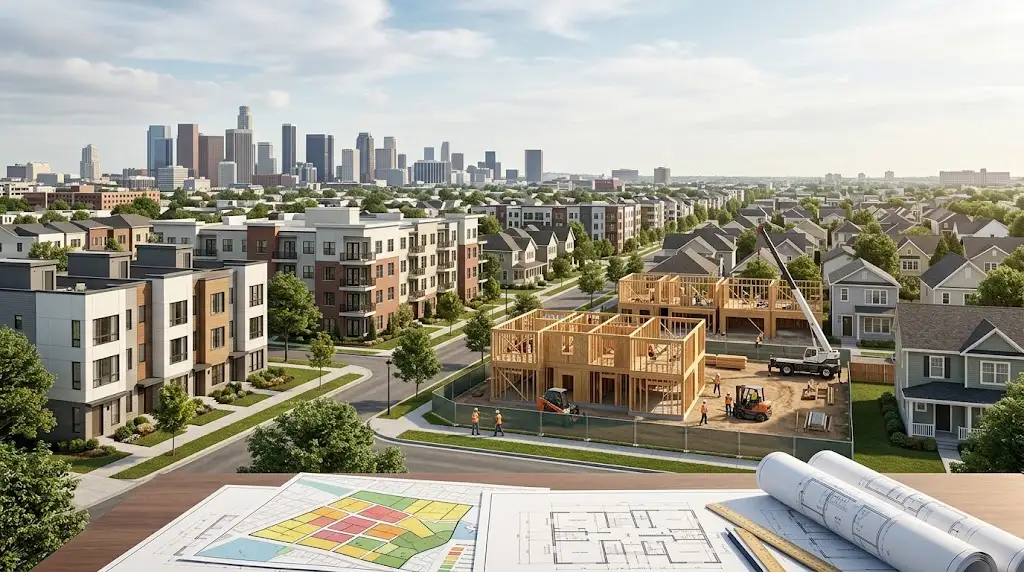
The U.S. housing affordability debate has increasingly shifted toward a question that goes beyond mortgage rates: how much housing can actually be built, where it can be built, and how much regulation adds to the cost of construction.
In 2026, the federal government has taken several steps aimed at reducing regulatory barriers to housing construction, changing Federal Housing Administration requirements, and giving state and local governments recommendations for increasing housing supply. The Department of Housing and Urban Development has described reducing barriers to affordable housing as a central priority of its 2026 housing strategy. HUD’s FY 2026 Annual Performance Plan specifically identifies regulatory barriers, construction costs, housing supply, and homeownership as areas of focus.
These changes do not guarantee lower home prices or rents. Housing markets operate locally, and the eventual effect will depend on how states, cities, builders, lenders, and households respond.
Why Housing Policy Matters
Housing affordability is influenced by several factors at the same time. Mortgage rates affect borrowing costs, household incomes affect purchasing power, and local housing supply affects the number of homes available to buyers and renters.
Regulations can also influence the cost and speed of development. Permitting requirements, zoning rules, building standards, land-use restrictions, infrastructure requirements, and other processes can affect whether a proposed housing project is financially viable.
HUD’s 2026 performance plan states that housing cost burdens have increased and identifies shortages of affordable supply as one factor affecting affordability. The department also points to regulatory barriers at federal, state, and local levels as an area it intends to address.
The 2026 Policy Direction: Reducing Regulatory Barriers
One of the clearest policy developments has been a federal emphasis on reducing regulations that the administration argues can increase housing construction costs or slow development.
In May 2026, HUD published State and Local Best Practices for Home Construction. The recommendations are organized around three broad areas: reducing construction costs, making more land available for housing, and accelerating construction timelines.
HUD says the recommendations are intended to help state and local governments review regulations that may be increasing construction costs or slowing housing production. The recommendations do not automatically change zoning or building rules in every community. State and local governments still play important roles in deciding how their housing markets are regulated.
Why Construction Costs Matter to Housing Affordability
A new home has many costs before it reaches a buyer. Land, labor, materials, financing, insurance, infrastructure, permitting, inspections, and regulatory compliance can all contribute to the final price.
If the cost of producing new housing rises, developers may have fewer financially viable projects. That can affect the number of homes entering the market.
HUD’s May 2026 report argues that regulatory costs can represent a substantial portion of new-home prices. Because those figures are estimates based on specific methodologies and assumptions, they should not be treated as a universal cost for every home or location.
The broader issue is straightforward: if policymakers can reduce unnecessary development costs without creating unacceptable safety or quality tradeoffs, construction may become easier to finance.
Local Zoning Remains a Major Factor
Federal housing policy does not operate in isolation. Local zoning decisions can determine whether land is available for single-family homes, apartments, townhomes, accessory dwelling units, manufactured housing, or other forms of residential development.
This makes local implementation important. A federal policy encouraging additional construction cannot by itself guarantee that a city will approve more housing projects.
HUD has emphasized greater local control as part of its current approach. In February 2025, HUD announced the termination of the Biden-era Affirmatively Furthering Fair Housing rule and said the action would return more zoning decision-making authority to state and local governments. HUD’s announcement presents the administration’s rationale for the change.
The policy has also been subject to political and policy disagreement. Supporters of local control emphasize community decision-making, while critics of reducing federal housing requirements can argue that stronger federal standards may be needed to address housing disparities and barriers that persist across local markets.
Housing Supply Could Become the Central Issue
A major question surrounding the policy shift is whether increasing the supply of homes can improve affordability.
More housing supply can create additional options for buyers and renters, particularly in markets where population growth and household formation are increasing demand. However, the effect is not necessarily immediate.
New construction takes time. Developers need land, financing, approvals, contractors, materials, and buyers or tenants. Existing homeowners and renters may also respond differently depending on local market conditions.
For people researching property markets, PostTrek’s Hugoton real estate guide and real estate investment coverage provide examples of how local market characteristics can differ from broader national trends.
FHA Mortgage Rules Are Also Changing
Housing affordability is not only about construction. Financing also determines whether households can purchase homes.
In June 2026, HUD announced 14 changes to its Federal Housing Administration single-family mortgage insurance program. According to HUD, the changes are intended to remove administrative barriers and make FHA financing more efficient for borrowers and lenders.
The changes matter because FHA-insured mortgages are an important source of financing for eligible homebuyers, including borrowers who may have smaller down payments available.
However, changing mortgage rules does not automatically make every home affordable. Buyers still face home prices, interest rates, insurance, property taxes, maintenance expenses, and lender qualification requirements.
Consumers interested in financing more broadly can also review PostTrek’s financing guide and financial decision-making coverage for related financial topics.
Building Codes Are Another Part of the Debate
Building standards are intended to address safety, durability, energy efficiency, accessibility, and other housing concerns. At the same time, policymakers often debate how expensive compliance should be and whether particular requirements create unintended barriers to construction.
In April 2026, HUD and USDA announced the rescission of a 2024 determination involving the 2021 International Energy Conservation Code for certain FHA- and USDA-backed new-home construction. HUD and USDA said the previous policy could increase construction costs and complicate development. The agencies’ April 2026 announcement explains the policy change and its stated rationale.
The broader policy question is not simply whether regulations should exist. It is how policymakers should balance construction costs with safety, environmental performance, energy efficiency, accessibility, and other public objectives.
Manufactured and Alternative Housing Could Gain Attention
Expanding the range of housing types is another possible part of the affordability discussion. Manufactured homes, modular construction, accessory dwelling units, smaller homes, and multifamily developments can provide alternatives to traditional detached housing.
HUD’s 2026 housing plan specifically mentions manufactured homes as one avenue for expanding affordable housing options.
This can be particularly relevant in areas where conventional single-family construction is expensive or land is limited.
Homeowners considering manufactured housing can also explore PostTrek’s guide to mobile-home maintenance and stability, which illustrates some of the practical considerations associated with this type of housing.
Public Housing Is Part of the Policy Shift Too
The current housing strategy also includes changes to public housing programs.
In August 2026, HUD announced updated guidance intended to give public housing authorities more flexibility when addressing distressed properties and considering redevelopment. HUD said the changes are designed to help authorities rehabilitate or replace deteriorating public housing while maintaining affordable housing opportunities.
HUD has also described a broader Restore-Rebuild initiative that can help housing authorities rebuild public housing units and restore rental assistance subsidies under existing authorities.
These programs address a different part of the housing challenge than private-market construction. Instead of focusing only on new market-rate housing, public housing initiatives deal with the preservation, rehabilitation, and replacement of publicly supported housing.
Could Lower Construction Costs Reduce Home Prices?
Potentially, but the relationship is not automatic.
If construction becomes less expensive, a developer may be able to build a project that previously did not make financial sense. More projects could eventually increase the supply of homes.
But developers also respond to land prices, labor costs, financing rates, expected demand, taxes, insurance, and local regulations. A reduction in one cost does not necessarily offset increases elsewhere.
Market competition also matters. In a high-demand area, additional supply may moderate price growth without causing existing home prices to fall sharply.
What Could Happen to Renters?
Renters are affected by the same supply-and-demand dynamics as homebuyers, although the relationship can take different forms.
Additional apartment construction can increase the number of rental units available. Over time, greater availability may affect rent growth, particularly in markets where new supply substantially exceeds the growth in demand.
However, new housing is often expensive to build, meaning newly constructed units are not necessarily affordable to households with the lowest incomes.
That is why housing affordability policy typically involves more than one approach, including new construction, preservation of existing affordable housing, rental assistance, financing programs, and local land-use decisions.
Why Interest Rates Still Matter
Regulatory reform is only one variable in the housing equation. Mortgage rates remain important because they influence monthly payments and purchasing power.
A lower-priced home can still be difficult for a household to afford when borrowing costs are high. Conversely, lower mortgage rates can increase purchasing power but may also increase demand if housing supply does not expand at the same pace.
For this reason, construction policy and mortgage policy are interconnected but should not be treated as identical solutions.
Housing Markets Are Highly Local
One of the biggest reasons housing-policy predictions are difficult is that there is no single U.S. housing market.
A rapidly growing Sun Belt city can face very different conditions from a smaller Midwestern community. Land availability, population growth, zoning, employment, construction costs, insurance, taxes, and existing housing stock can all vary considerably.
PostTrek’s coverage of Vermont real estate, Tidioute, Pennsylvania real estate, and Lostine, Oregon real estate illustrates how property markets can differ substantially by location.
What the Policy Shift Does Not Solve Automatically
Reducing regulatory barriers does not eliminate every cause of housing affordability problems.
Other challenges include:
- High land costs
- Construction labor shortages
- Material costs
- Mortgage rates
- Property taxes
- Homeowners insurance costs
- Infrastructure limitations
- Local opposition to development
- Income and wage differences
- Demand growth in high-cost markets
A durable improvement in housing affordability therefore depends on multiple factors rather than one policy decision.
What Homebuyers Should Watch
Consumers following the housing market can watch several indicators rather than relying on headlines alone.
New Housing Permits
Building permits can provide an early indication of whether developers are planning additional housing.
Housing Completions
Permits do not automatically become finished homes. Construction completions provide a clearer picture of actual additions to supply.
Mortgage Rates
Borrowing costs can materially change monthly housing payments even when home prices remain unchanged.
Inventory
The number of homes available for sale can influence how much negotiating power buyers have.
Local Zoning Changes
Changes to density rules, permitting procedures, accessory dwelling units, multifamily development, or minimum lot sizes can affect local housing supply.
Rental Supply
For renters, apartment construction and vacancy rates can provide useful information about local market conditions.
Could Technology Change Housing Construction?
Technology is another factor that could influence construction costs and productivity over time. Digital design, construction-management software, prefabrication, smart-home systems, and other technologies can change how buildings are designed and operated.
PostTrek’s coverage of smart-home technology provides an example of how technology is becoming part of modern residential environments.
However, technology cannot independently solve shortages of land, financing, skilled labor, or local approvals. Its effect depends on how widely these tools are adopted and whether they reduce total project costs.
What Investors and Property Owners Should Consider
Property investors and owners may need to pay particular attention to local policy changes. A zoning amendment that allows greater density can change development possibilities, while changes to building requirements can affect renovation or construction budgets.
At the same time, policy changes can produce different outcomes for different property types. A rule benefiting new construction may affect developers differently from existing homeowners or landlords.
Readers interested in property investment can also review PostTrek’s coverage of real-estate asset strategies and property investment opportunities.
The Bigger Question: Supply, Affordability, or Both?
The housing-policy debate often combines two related but different goals: increasing the number of homes and making housing affordable to households with limited incomes.
Increasing supply can address shortages, but newly constructed homes may initially be priced above what lower-income households can afford. Direct assistance and preservation programs may therefore remain relevant even if construction increases.
Conversely, subsidies without sufficient housing supply can face their own limitations if too many households compete for too few homes.
This is why housing policy involves tradeoffs between construction, regulation, financing, subsidies, preservation, and local land use.
What the 2026 Policy Changes Mean
The current federal approach represents a significant shift in emphasis toward reducing regulatory barriers, encouraging housing construction, changing mortgage-program requirements, and giving states and localities recommendations for improving development processes.
HUD’s stated objective is to make housing construction and homeownership more accessible. Whether these policies produce substantial improvements in affordability will depend on implementation and the response of local governments, builders, lenders, investors, renters, and buyers.
Some effects may appear relatively quickly in permitting or financing processes, while changes to housing supply can take years to become visible.
Final Thoughts
The policy shift surrounding the U.S. housing crisis is best understood as a collection of changes rather than one single rule.
In 2026, federal housing policy has placed greater emphasis on reducing regulatory barriers, encouraging construction, reviewing mortgage requirements, expanding housing options, and improving the use of existing public housing.
Supporters argue that lowering unnecessary costs and increasing supply can improve affordability over time. Critics and housing-policy analysts may raise questions about whether deregulation alone can address affordability, particularly for lower-income households and communities facing severe housing shortages.
The eventual outcome will depend heavily on what happens beyond federal policy: local zoning decisions, construction activity, financing conditions, population growth, household incomes, land availability, and the cost of building and maintaining homes.
For anyone following the housing market, the most useful approach is therefore to look beyond a single policy announcement and track actual changes in housing supply, construction, mortgage costs, rents, inventory, and local development rules.