
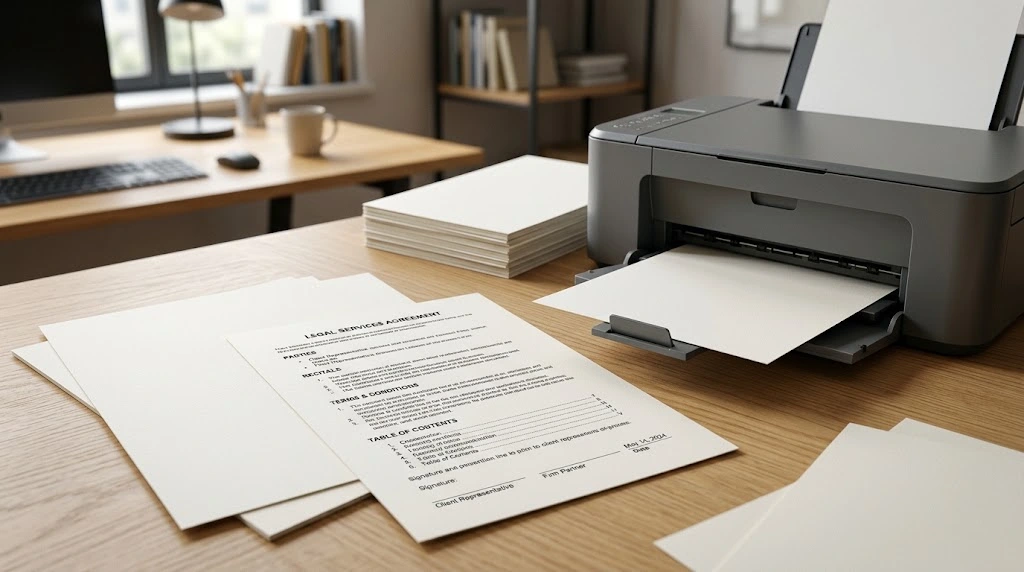
Legal size cardstock combines the larger dimensions of U.S. legal paper with the heavier feel of cardstock, making it useful for brochures, certificates, presentation materials, forms, menus, invitations, and other projects that need more space and a sturdier finish.
What Is Legal Size Cardstock?
Legal size cardstock is a heavier paper stock cut to the U.S. legal paper format of 8.5 × 14 inches. It is wider than some common specialty formats but, most importantly, it is longer than standard letter-size paper.
The larger canvas can be useful when a project needs additional room for tables, signatures, graphics, instructions, photographs, or other content without moving to a much larger paper format.
It is important to distinguish size from weight. Legal refers to the dimensions of the sheet. Cardstock refers to the heavier, more substantial paper category. A legal-size sheet can therefore be produced in different weights and finishes.
Legal Size vs. Letter Size Cardstock
The most important difference is length. U.S. letter paper measures 8.5 × 11 inches, while U.S. legal paper measures 8.5 × 14 inches. HP’s printer documentation likewise lists U.S. Legal at 8.5 × 14 inches and U.S. Letter at 8.5 × 11 inches. HP’s paper-size guidance is a useful reference when checking printer compatibility.
| Feature | Letter Size | Legal Size |
|---|---|---|
| Dimensions | 8.5 × 11 inches | 8.5 × 14 inches |
| Width | 8.5 inches | 8.5 inches |
| Length | 11 inches | 14 inches |
| Primary advantage | Common and widely supported | More vertical space |
| Typical use | Everyday documents | Longer forms, layouts, presentations and specialty projects |
Why Choose Legal Size Cardstock?
Legal size cardstock can be a practical choice when standard letter dimensions are too restrictive but a larger poster or oversized sheet would be unnecessary.
More Room for Content
The additional three inches of length can make a meaningful difference. Designers can use the extra area for charts, product information, terms and conditions, instructions, signatures, photographs, or additional branding elements.
A More Substantial Feel
Cardstock generally feels sturdier than ordinary office paper. That tactile difference can be useful for materials where presentation matters, such as certificates, menus, invitations, promotional pieces, and client-facing documents.
Flexible Layout Options
The legal format can work in portrait or landscape orientation. Landscape layouts can be especially useful when a design requires additional horizontal space after folding or when several columns need to remain readable.
Common Uses for Legal Size Cardstock
The best application depends on the cardstock’s weight, finish, printer compatibility, and intended handling. Some common uses include:
- Professional presentations
- Business forms
- Certificates and awards
- Menus
- Event programs
- Brochures and promotional materials
- Photography and portfolio layouts
- Instruction sheets
- Educational materials
- Invitations and announcements
- Real estate marketing materials
- Legal and administrative documents that require additional space
For projects involving legal terminology or document-related themes, you may also find our guide to the legal document crossword clue useful.
How to Choose the Right Cardstock Weight
Cardstock is available in different weights and thicknesses, and there is no single weight that is best for every legal-size project.
Lightweight Cardstock
Lightweight stock can be a good choice when you want more structure than ordinary paper without making the finished piece excessively rigid. It can work well for informational sheets, handouts, and some brochures.
Medium-Weight Cardstock
Medium-weight cardstock offers a balance between durability and printability. It is often suitable for menus, certificates, invitations, promotional materials, and presentation pages.
Heavy Cardstock
Heavy stock creates a noticeably more rigid and premium result. It can be appropriate for covers, formal certificates, high-end invitations, and other materials where durability is important.
Before purchasing a large quantity, check your printer’s maximum supported media thickness. A sheet that fits dimensionally may still be too heavy for a particular printer’s feed mechanism.
Choosing Between Matte, Glossy and Textured Finishes
Matte Cardstock
Matte finishes reduce surface glare and can make text easier to read under many lighting conditions. They are often a strong choice for reports, certificates, menus, and text-heavy designs.
Glossy Cardstock
Glossy surfaces can make photographs and colorful graphics appear more vibrant. They are worth considering for visual marketing materials, photo-heavy designs, and promotional pieces.
Textured Cardstock
Textures such as linen or felt can add visual and tactile interest. They can work particularly well for invitations, certificates, stationery, and formal event materials.
When selecting a finish, think about how the recipient will actually use the printed piece. A highly reflective finish may look attractive in photographs but can be less comfortable for reading large amounts of text.
Can You Print Legal Size Cardstock at Home?
Yes, but printer compatibility is essential. Not every home or office printer supports both legal dimensions and heavier cardstock.
Check the printer’s specifications for three things:
- Paper size support: Confirm that U.S. Legal or 8.5 × 14-inch media is supported.
- Media weight: Check the maximum supported cardstock or paper thickness.
- Feed path: Some printers handle heavier media more reliably through a specific tray or manual-feed slot.
HP documentation, for example, lists Legal at 8.5 × 14 inches for compatible printer models and advises users to select the correct paper size and type in the print driver. Check the printer’s supported media specifications before printing.
How to Print Legal Size Cardstock Correctly
1. Select Legal Paper Size
Set the document and printer to Legal or 8.5 × 14 inches. Do not simply place legal paper into a printer while leaving the software set to Letter.
2. Select the Correct Paper Type
If your printer provides a cardstock or heavy-paper setting, choose the setting appropriate for your material. This can affect how the printer feeds and processes the sheet.
3. Check the Feed Tray
Some printers have different trays for different media types. If the manufacturer’s instructions specify a manual feed or particular tray for heavy media, follow those instructions.
4. Test Before the Full Print Run
Print one or two test sheets before committing to a large batch. Check alignment, color, margins, drying, duplex performance, and whether the sheet feeds smoothly.
5. Allow Ink to Dry
Depending on the printer, ink, coating, and cardstock finish, printed surfaces may need additional drying time. Avoid immediately stacking freshly printed sheets if the ink is still susceptible to smearing.
Design Tips for Legal Size Cardstock
The larger format gives you more room, but additional space does not automatically produce a better design. Use the dimensions deliberately.
Keep Margins Consistent
Leave enough breathing room around the edges. Do not fill every available inch simply because the sheet is larger.
Use a Clear Visual Hierarchy
Separate headings, supporting information, graphics, and calls to action so the reader can understand the page quickly.
Plan for Folding
If the legal sheet will become a brochure or folded handout, create guides before designing the final layout. Account for panel widths and the direction of the fold.
Consider Duplex Printing
Double-sided printing can make legal cardstock useful for multi-page presentations and information sheets. However, verify that both the printer and cardstock support duplex printing at the chosen weight.
Legal Size Cardstock for Business and Marketing
Businesses can use the additional space to create documents that are easier to organize visually. A longer page can accommodate a combination of text, charts, pricing information, images, and contact details without shrinking everything to fit a standard sheet.
For example, a service company could use legal cardstock for a detailed proposal, while an event organizer might use it for a multi-section program. A real estate professional could use the format for a property information sheet with photographs, specifications, and contact information.
The key is not simply using a larger sheet. The design should make the additional space useful.
Legal Size Cardstock for Certificates and Formal Documents
Certificates can benefit from cardstock because the heavier material can provide a more substantial presentation than ordinary copy paper.
When creating a certificate, leave enough space for names, dates, signatures, seals, and other required information. A landscape legal layout can also provide a wide visual field for decorative borders and centered typography.
Always check the requirements of the organization issuing or accepting the certificate before selecting a paper format.
How to Store Legal Size Cardstock
Proper storage helps prevent curling, warping, discoloration, and surface damage.
- Store sheets flat whenever possible.
- Keep cardstock away from excessive moisture.
- Avoid prolonged exposure to direct sunlight.
- Keep coated surfaces protected from scratches.
- Do not place heavy objects on delicate textured stock.
- Keep unused cardstock in its original packaging when practical.
Environmental conditions can affect paper, especially during long-term storage. If a project is scheduled months in advance, inspect the material before the final print run.
Eco-Friendly Legal Size Cardstock Options
If sustainability is important to your project, look for cardstock made with recycled content or responsibly sourced fiber. The Forest Stewardship Council provides certification systems for responsibly sourced forest-based materials, including paper products.
FSC distinguishes between labels such as FSC 100%, FSC Mix, and FSC Recycled. Its U.S. guidance explains that FSC Recycled products contain 100% recycled fiber, while FSC Mix products combine FSC-certified material and/or recycled materials with controlled virgin fiber. Learn what FSC paper labels mean.
When sustainability claims matter for a business or organization, verify the certification and supplier information instead of relying solely on generic terms such as “eco-friendly.”
Legal Size Cardstock vs. Other Specialty Paper
Choosing cardstock is ultimately a combination of size, weight, finish, and purpose.
| Material Choice | Best For | Main Consideration |
|---|---|---|
| Legal cardstock | Longer, sturdy documents and specialty layouts | Printer must support size and weight |
| Letter cardstock | Common cards, covers and handouts | Less vertical space |
| Standard legal paper | Long-form office documents | Less rigid than cardstock |
| Glossy photo stock | Photography and image-heavy designs | Surface glare and ink compatibility |
| Textured specialty stock | Invitations and formal stationery | Printer compatibility and readability |
How Much Legal Size Cardstock Do You Need?
Calculate your quantity based on the final number of printed pieces rather than simply estimating by project size.
For example, if you need 100 finished sheets, consider ordering a small amount of extra stock for test prints, setup waste, occasional feeding problems, and damaged sheets.
For a large commercial run, ask the printer about recommended quantities and whether the exact cardstock is available consistently. Matching paper between separate print runs can sometimes be more difficult than expected when the manufacturer changes stock or finishes.
Frequently Asked Questions About Legal Size Cardstock
What size is legal cardstock?
U.S. legal cardstock measures 8.5 × 14 inches, or approximately 216 × 356 mm. The legal designation describes the sheet dimensions, while cardstock describes its heavier paper construction.
Is legal size cardstock the same as letter size cardstock?
No. Both are 8.5 inches wide, but legal stock is 14 inches long while letter stock is 11 inches long.
Can any printer print on legal size cardstock?
No. The printer must support both the 8.5 × 14-inch legal format and the thickness or weight of the cardstock. Always check the manufacturer’s specifications.
What is legal cardstock commonly used for?
Common applications include certificates, menus, brochures, presentations, business forms, invitations, promotional materials, and longer documents requiring a sturdier sheet.
Is heavier cardstock always better?
No. The ideal weight depends on the project and printer. Very heavy stock may feel premium but can be harder to feed, fold, or print on certain equipment.
Should I choose matte or glossy cardstock?
Choose matte when readability and reduced glare are priorities. Glossy can be useful for photographs and vibrant graphics. The best choice depends on the design and viewing environment.
Final Thoughts
Legal size cardstock is a useful option when you need the extra length of an 8.5 × 14-inch sheet combined with the sturdier feel of cardstock. The format can work for professional documents, certificates, marketing materials, menus, invitations, and many other projects.
The best results come from treating size, weight, finish, printer compatibility, and design as one decision. Check your printer specifications before purchasing, test the material before a large print run, and select a finish that matches the way readers will interact with the finished piece.
With the right combination of material and layout, legal size cardstock can provide additional design space without requiring an oversized printing format.