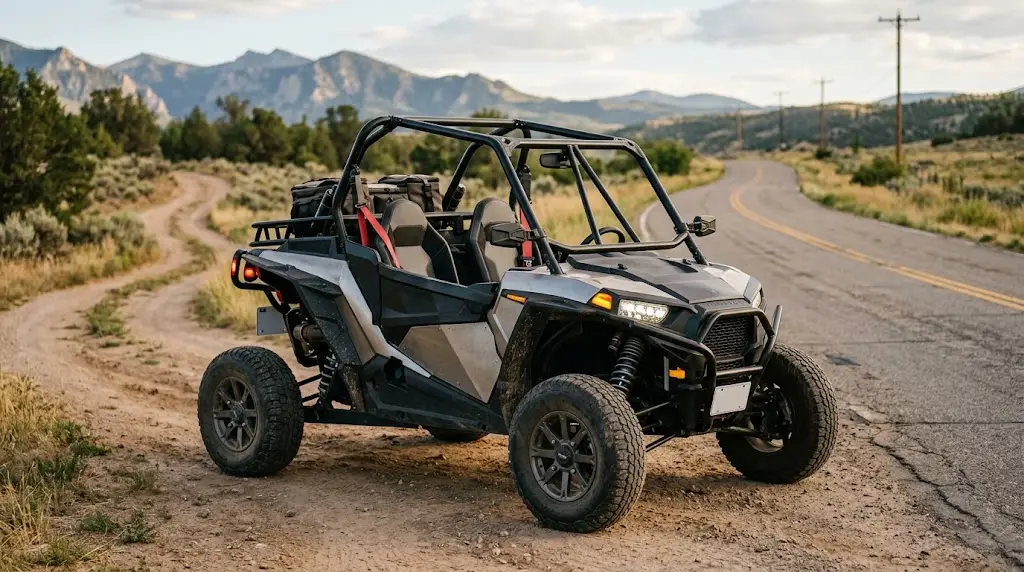
That makes the conversion process more than a parts upgrade. You need to consider the vehicle’s design, required safety equipment, title and registration status, insurance, emissions requirements, and the roads where you intend to operate it.
This guide explains what a street legal buggy kit typically includes, how to evaluate a kit, what to check before installation, and why state-specific verification should come before spending money on conversion parts.
What Is a Street Legal Buggy Kit?
A street legal buggy kit is generally a collection of equipment intended to add road-use components to an off-road buggy or similar recreational vehicle. Depending on the vehicle and jurisdiction, a kit may include lighting, turn signals, mirrors, a horn, wiring components, switches, a license-plate mount, reflectors, and other required equipment.
However, there is no single nationwide parts list that automatically makes every buggy street legal. State laws can determine whether a particular vehicle can be registered for public-road use in the first place.
For example, some jurisdictions provide a registration pathway for certain off-highway vehicles, while others place substantial restrictions on converting or operating vehicles originally designed exclusively for off-road use.
What Does a Street Legal Buggy Kit Usually Include?
The exact contents depend on the buggy, manufacturer, and applicable regulations. Before buying a kit, compare its components with your state’s requirements instead of assuming that a universal package will satisfy every rule.
1. Headlights and Required Lighting
Proper lighting is one of the most important parts of a road-use conversion. Depending on local requirements, a buggy may need headlights, tail lamps, brake lights, turn signals, hazard flashers, and reflectors.
The existing factory lighting should be inspected before adding aftermarket components. A kit should also be compatible with the buggy’s electrical system and provide reliable wiring, switches, connectors, and protection against vibration and moisture.
2. Turn Signals
Turn signals help communicate your intentions to other road users and are commonly included in street-use conversion kits. A complete system may include front and rear indicators, a control switch, a flasher or relay, wiring, and mounting hardware.
Do not judge a kit only by whether the lights illuminate. Installation quality, visibility, wiring protection, and compliance with the applicable state requirements all matter.
3. Mirrors
Rear-view mirrors can be an important requirement for road use. They also improve situational awareness when a buggy is sharing pavement with cars, trucks, motorcycles, and other traffic.
Choose mirrors that provide a useful rearward field of view and remain securely mounted to the vehicle. A mirror that constantly moves because of vibration is not a meaningful safety upgrade.
4. Horn
A horn may be required for vehicles permitted on public roads. When selecting a kit, verify that the horn, button, wiring, and mounting hardware are appropriate for the vehicle.
5. License Plate Mounting and Illumination
If your jurisdiction requires a license plate for the vehicle, the buggy needs an appropriate mounting location. Some road-use frameworks also require the plate to be illuminated.
Check the registration instructions for your state before drilling mounting holes or modifying the bodywork.
6. Safety and Restraint Equipment
Many recreational buggies already have safety features such as seat belts and roll structures. These components should be inspected rather than assumed to be compliant simply because they came with the vehicle.
A street-use conversion should never compromise the vehicle’s original restraint system, rollover protection, steering, braking, or suspension components.
Is a Buggy Automatically Street Legal After Installing a Kit?
No. This is one of the most important points to understand.
A street legal buggy kit is an equipment package, not a universal legal certification. Whether your buggy can be operated on public roads depends on the laws that apply to the vehicle and location.
Some states distinguish between ATVs, UTVs, recreational off-highway vehicles, dune buggies, specially constructed vehicles, and other vehicle classifications. Those definitions can affect registration and road-use eligibility.
California, for example, treats UTVs as a specific category of off-highway vehicle and states that four-wheel ATVs cannot be registered for on-highway use. Arizona, by contrast, provides specific classifications under which qualifying off-highway vehicles can be registered for on-road use when the applicable equipment requirements are met.
This illustrates why a kit advertised as “street legal” should never be treated as a guarantee that your particular buggy is legal everywhere.
How to Check Whether Your Buggy Can Be Made Street Legal
Before purchasing a conversion kit, work through the legal side first.
- Identify the vehicle classification. Determine whether your buggy is treated as an ATV, UTV, ROV, dune buggy, specially constructed vehicle, or another category.
- Check your state’s motor vehicle agency. Look for the official rules covering registration and public-road operation.
- Check local restrictions. A state may permit certain vehicles while a city, county, or specific road imposes additional restrictions.
- Verify title and VIN requirements. Registration may depend on the vehicle’s title history, VIN, manufacturer’s documentation, or construction status.
- Review required equipment. Confirm requirements for lights, signals, mirrors, brakes, tires, horn, windshield, reflectors, seat belts, and other equipment.
- Check insurance requirements. Confirm that your insurer will cover the vehicle in the intended configuration and use.
- Confirm inspection or emissions requirements. Some jurisdictions may require inspections, emissions compliance, or additional documentation.
Street Legal Buggy Kit vs. Building a Custom Setup
There are two common approaches: buying a bundled conversion kit or sourcing each component individually.
Using a Complete Kit
A complete kit can simplify installation because compatible components are packaged together. It may reduce the time spent finding switches, wiring, relays, lights, mirrors, and mounting hardware separately.
The key advantage is convenience, not guaranteed legality. You still need to confirm that the kit works with your vehicle and satisfies the rules applicable to your location.
Building Your Own Setup
A custom setup can make sense for experienced builders who want to choose individual components. It can also be useful when a standard kit does not fit a particular buggy.
The downside is compatibility. You are responsible for selecting appropriate components, protecting the wiring, positioning lights and mirrors correctly, and ensuring that the finished vehicle meets the applicable requirements.
What to Look for When Buying a Street Legal Buggy Kit
Vehicle Compatibility
Start with the exact make, model, year, electrical system, and configuration of your buggy. A kit designed for one vehicle may not fit another even if both machines appear similar.
Component Quality
Look for durable switches, connectors, wiring, lamps, mounting hardware, and weather-resistant components. Off-road vehicles experience vibration, dust, mud, water, and impacts that can expose weak components quickly.
Installation Instructions
A useful kit should provide clear installation instructions and identify each major component. Poor documentation can turn a relatively simple electrical project into a troubleshooting exercise.
Replacement Parts
Consider whether replacement switches, relays, lamps, connectors, and other components will remain available. A kit is more useful over the long term when individual parts can be replaced without rebuilding the entire system.
Legal Documentation
Be cautious when a seller uses broad phrases such as “100% street legal” without explaining where the claim applies. Ask what standards or regulations the components are intended to satisfy and whether the claim applies to the equipment or to the complete vehicle.
Why Tires Matter on a Street Legal Buggy
Tires are especially important when moving between trails and pavement. Off-road tires can provide excellent traction in dirt, mud, sand, or rocky terrain, but their characteristics can differ substantially from tires designed for sustained pavement use.
Before choosing tires for a road-capable buggy, consider size, load capacity, speed rating where applicable, tread design, wheel compatibility, clearance, and the manufacturer’s recommendations.
Proper sizing is important for handling and mechanical compatibility. Our guide on why proper tyre size matters when buying new tyres provides additional context on why fitment should be evaluated before focusing on brand alone.
Do Not Ignore Brakes and Suspension
Adding road equipment does not improve a buggy’s mechanical condition. Before using a converted vehicle on pavement, inspect the braking system, steering, suspension, wheel bearings, tires, fasteners, and other safety-critical components.
Regular inspection becomes even more important when a buggy is frequently exposed to mud, water, dust, jumps, rough terrain, and heavy vibration.
For broader vehicle-maintenance guidance, you can also explore our article on professional auto service and vehicle care.
Maintenance After Installing a Street Legal Buggy Kit
A conversion kit should be treated as part of an ongoing maintenance routine rather than a one-time modification.
- Inspect wiring for rubbing, loose connections, and exposed conductors.
- Check turn signals and brake lights before road use.
- Confirm that mirrors remain firmly mounted.
- Inspect the horn and control switches.
- Check tire pressure and tread condition.
- Inspect brake components regularly.
- Check suspension and steering components for excessive play.
- Inspect mounting hardware after significant off-road use.
- Clean mud and debris from electrical components where appropriate.
- Follow the buggy manufacturer’s maintenance schedule.
For additional tire-related maintenance information, see our guide to run-flat tyre installation and inspection.
You can also explore other automotive maintenance resources on PostTrek, including vehicle care and auto service, automotive care services, reliable car care, and precision automotive service.
Street Legal Buggy Kit Cost Considerations
The price of a conversion can vary considerably depending on the buggy, the equipment already installed, the quality of the components, and the amount of professional work required.
Instead of comparing kits by price alone, calculate the complete project cost. Include the kit, installation supplies, replacement components, tires if required, registration-related expenses, inspections, insurance, and any additional modifications required by your state.
A cheaper kit can become expensive if components fail early or if it does not provide the equipment required for your particular vehicle.
Common Mistakes to Avoid
Assuming the Seller’s Claim Applies Everywhere
“Street legal” is not a universal status. Always verify the rules where you plan to operate the buggy.
Buying Before Checking Registration Eligibility
Do not purchase hundreds of dollars of conversion equipment before confirming that your vehicle can legally receive the registration or title status you need.
Focusing Only on Lights
Lighting is important, but road legality can involve much more than headlights and turn signals. Registration, vehicle classification, tires, mirrors, braking equipment, insurance, emissions requirements, and operating restrictions may also matter.
Ignoring Local Rules
Even where state law provides a pathway for road use, local authorities can impose additional restrictions. Check the rules for the specific roads and areas where you intend to ride.
Skipping Mechanical Inspection
A buggy that works well on a trail still needs to be mechanically sound before sharing public roads with other traffic. Check the brakes, steering, suspension, tires, lights, restraints, and electrical system before road use.
Can You Use the Same Buggy for Trails and Public Roads?
In some jurisdictions and with qualifying vehicles, a buggy may be used for both off-road recreation and permitted public-road travel. However, the legal classification and equipment requirements determine whether that dual use is allowed.
Even when it is legal, mixed-use driving places different demands on the vehicle. Trail riding can expose components to impacts and debris, while pavement introduces higher-speed traffic and different handling conditions.
A sensible approach is to inspect the vehicle after demanding off-road trips and before returning to public-road operation.
Are Street Legal Buggy Kits Worth It?
For the right vehicle and jurisdiction, a street legal buggy kit can be a practical way to add road-use equipment without designing every component from scratch.
The value depends on three things: legal eligibility, component quality, and proper installation. A well-designed kit installed on an eligible vehicle can simplify the conversion process. A poorly matched kit cannot overcome a registration restriction or make an otherwise ineligible vehicle legal.
Final Checklist Before Driving on Public Roads
Before taking your buggy onto public roads, confirm each of the following:
- Your vehicle is eligible for the type of road use you intend.
- You have verified the applicable state and local requirements.
- The required registration, title, or identification process is complete.
- Required insurance is in place.
- Lights and turn signals operate correctly.
- Mirrors provide an adequate rearward view.
- The horn works correctly.
- Tires are appropriate and properly maintained.
- Brakes, steering, and suspension have been inspected.
- Seat belts and other safety equipment are secure.
- Any required inspection or emissions requirements have been satisfied.
- You understand where the vehicle may legally be operated.
Conclusion
A street legal buggy kit can make a recreational vehicle better prepared for permitted road use, but the kit itself is only one part of the process. The most important step is confirming that your specific buggy can legally be registered and operated where you intend to drive it.
Once eligibility is established, choose quality components, install them correctly, maintain the vehicle carefully, and verify the requirements again if you move to another state or change the vehicle’s configuration.
The best conversion is not simply the one with the most accessories. It is the one that combines legal eligibility, reliable equipment, sound mechanical condition, and responsible operation.