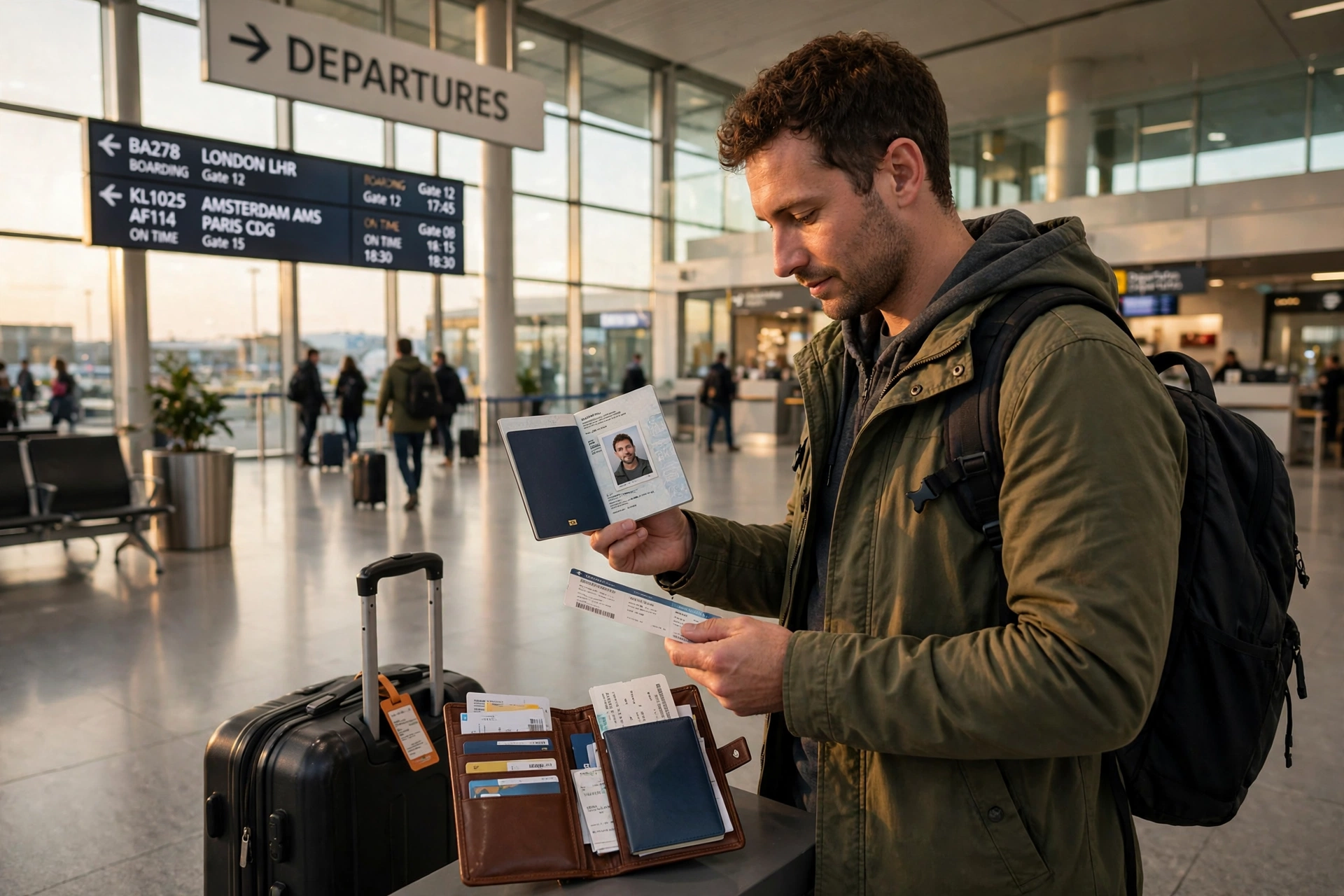
A carry-on backpack must do two jobs at once: hold everything you need, and fit the space your airline actually allows. Get the second wrong, and your bag disappears into the hold at the gate.
Choosing well means matching four things — your airline’s limit, your trip length, your body, and the way you pack — before you spend anything.
Start With Your Airline’s Limit, Not the Litre Number
Backpack sizes are usually sold in litres, but airlines do not measure litres. They measure length, width and depth, and sometimes weight. A 40-litre bag from one brand can be taller and slimmer than a 40-litre bag from another, so the litre figure alone tells you almost nothing about whether a bag will fit.
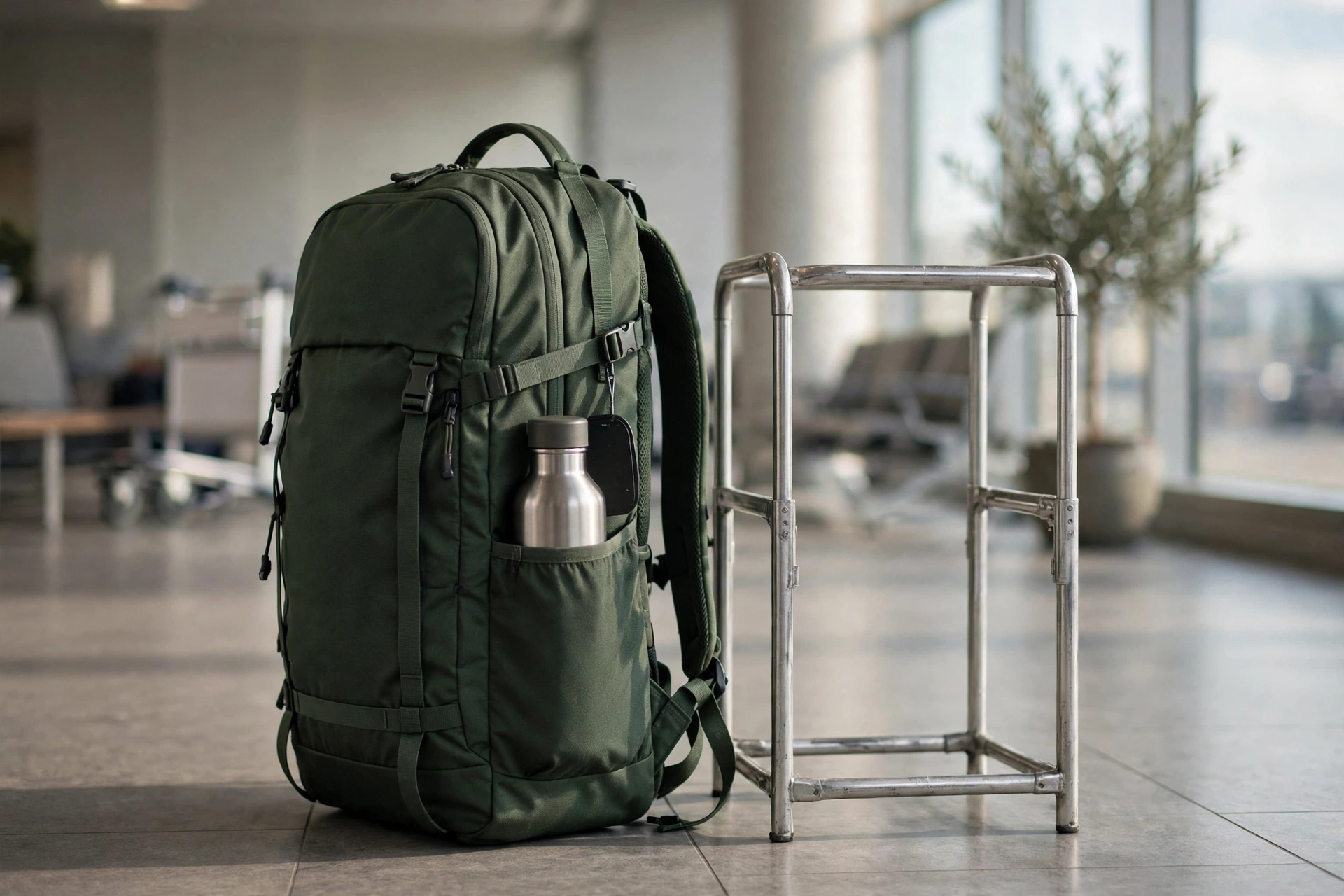
Start by checking the carry-on limit published by the airline you will fly with, on its own website. Limits vary by airline, route and fare type, and budget carriers often allow a smaller bag. A maximum of around 22 x 14 x 9 inches (about 56 x 36 x 23 cm) is commonly seen on larger airlines, but treat that as a starting point for comparison, never as a guarantee for your flight.
Then measure the bag the way the airline will: fully packed, with wheels, handles, straps and side pockets included. Depth is the dimension most travellers get wrong. A bag that measures fine when empty can easily grow once it is stuffed, and a water bottle in a side pocket or a jacket strapped to the outside counts too. If you cannot close every strap and pocket and still fit the bag into the airline’s stated dimensions, it is not a carry-on for that flight, however it was advertised.
Weight matters on some routes too: several international carriers set a carry-on limit, often around 7 to 10 kilograms, so weigh the empty bag before you buy.
Match the Size to the Trip, Not the Sale
Bigger is not better when the bag has to fit overhead. The right size is the smallest bag that comfortably holds what you genuinely need for that trip, with a little room left over so you are not forcing the zips shut.
As a rough rule of thumb, many travellers find that a weekend trip fits in roughly 25 to 35 litres, a week in roughly 35 to 45 litres, and longer or colder-weather trips push towards the top of the carry-on range. Your own needs will shift that: camera gear, work equipment and bulky cold-weather clothing all take space that a warm-weather trip does not.
Packing method matters more than bag size here. Learning how to pack light for a week-long trip will do more for you than buying a larger bag, because a well-packed smaller bag stays within the size limit while an overstuffed large one does not. If you are travelling alone, a step-by-step guide to planning your first solo trip can help you settle the itinerary first, so you pack for the trip you are actually taking rather than for every possibility. Count the extras too: laptop, book, bottle and jacket are part of the load, and if they only fit hanging off the outside, the bag is too small.
Fit and Comfort: Try It Loaded, Not Empty
A carry-on is worn through airports, up station stairs and across city streets, often longer than you expect — comfort is what stops it becoming a burden on day two.
Judge how the bag sits on your body, not how it looks on a shelf: padded, adjustable shoulder straps, a hip belt that transfers weight to your hips, a sternum strap, and load-lifter straps all matter — and none of it can be judged with an empty bag.
Try it loaded with roughly the weight you will carry, walk for ten minutes, and go up and down stairs. Notice where it pulls and whether straps dig in. If buying online, use the return window for this test at home — a bag that hurts in ten minutes will not improve in ten days.
Openings and Compartments That Save Time
How a bag opens decides how easy it is to live out of. A clamshell opening, where the bag unzips fully like a suitcase, makes packing and finding things far easier than a narrow top-loading opening, where everything at the bottom stays buried. For carry-on travel, where you may need to repack in a hotel room or pull something out at security, that difference shows up every day.
Look for a padded laptop compartment that is easy to reach without unpacking the whole bag, and a quick-access pocket at the top or front for the things you need in transit: phone, headphones, a pen, and your travel documents. Keeping your passport and boarding pass in one reachable pocket avoids the familiar airport scramble, and a travel documents checklist before an international flight helps you confirm you have everything before that pocket is zipped shut.
Inside, keep it simple: one main compartment, one laptop sleeve and one or two pockets beat a bag full of tiny pouches.
Materials, Zippers and Weather Protection
A carry-on bag takes knocks: overhead bins, wet pavements and the occasional rain shower. The fabric does not need to be the toughest on the market, but it should feel dense and sturdy rather than thin and papery, and the seams should be neat and reinforced at stress points such as strap attachments.
Zippers deserve a close look, because a failed zipper can end a bag’s useful life. They should run smoothly when the bag is full, not just when it is empty, and larger, chunkier zips generally cope better with a packed bag than fine, delicate ones.
On weather, note that water-resistant is not waterproof: most travel bags cope with light rain, so use a rain cover or a dry bag inside for electronics in heavy rain.
The 10-Minute Test Before You Buy
Before you commit, run this check: note your airline’s size and weight limit; measure the bag fully packed, including handles and side pockets; pack your real trip list and weigh it; wear it loaded for ten minutes, including stairs; and confirm it closes comfortably with nothing strapped outside. A bag that fails any step is the wrong bag for that trip.
Mistakes That Get a Bag Gate-Checked
Most gate checks come down to a few avoidable mistakes. Overstuffing is the first: a bag bulging beyond its stated depth will not fit the sizing frame, so pack it, measure it, and remove something rather than forcing the zip. Loose straps and dangling items are the second: tuck straps away and keep everything inside the bag’s own dimensions.
The third mistake is assuming every airline plays by the same rules: a bag that flew on one carrier can be gate-checked on another, especially on a connecting flight, so buy for the smallest limit on your journey. And do not confuse a carry-on with a personal item — they are separate allowances with separate limits.
Final Thoughts
Choosing a carry-on backpack is an exercise in honesty: about your airline’s limit, your real packing list, and how much weight you will carry. Start with the dimensions, pick the smallest size that fits your trip, test it loaded, and favour a simple, well-made layout. The right bag is the one you stop thinking about — because it fits and carries comfortably.
Frequently Asked Questions
Can I use a hiking backpack as a carry-on?
Yes, if it fits your airline’s limits when fully packed — but hiking bags are often taller and deeper, and external straps and frames can push them over. Measure it packed and tuck straps away first.
What size backpack fits most airlines as a carry-on?
No single size fits every airline. Around 22 x 14 x 9 inches (about 56 x 36 x 23 cm) is commonly seen on larger airlines, but budget carriers often allow less — always check your own airline’s limit.
Is a bigger litre capacity always better for travel?
No. A larger bag tempts you to pack more, weighs more empty, and is more likely to exceed a limit. Choose the smallest bag that holds your real list with room to spare.