
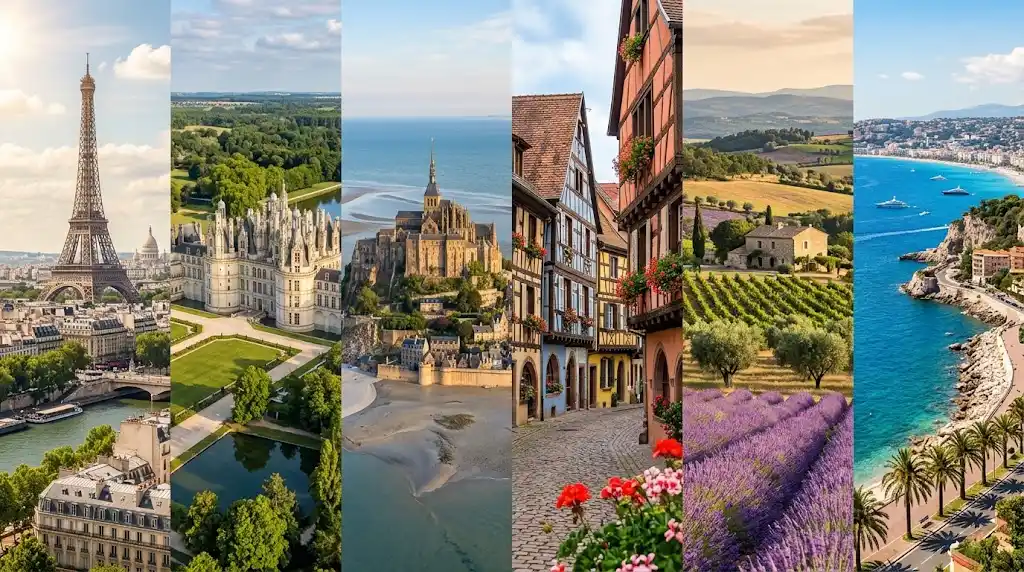
This France travel overview highlights some of the most popular places to visit in France and explains what makes each destination worth adding to your itinerary.
1. Paris
Paris is the natural starting point for many trips to France. The capital combines world-famous architecture, museums, historic neighborhoods, cafés, shopping streets, gardens, and an enormous range of cultural experiences.
Visitors can explore the Eiffel Tower, Louvre Museum, Notre-Dame area, Montmartre, Champs-Élysées, Seine riverbanks, Luxembourg Gardens, and numerous smaller neighborhoods that reveal a different side of the city.
Paris is also a useful base for exploring attractions outside the city. Travelers can combine a Paris stay with destinations such as Versailles and other locations in the surrounding region.
If you enjoy discovering major international cities, you may also want to compare this experience with our guide to top places to visit in Los Angeles or explore unusual places to visit in London.
2. Nice and the French Riviera
Nice is one of the most attractive destinations on France’s Mediterranean coast. Its combination of beaches, historic streets, markets, museums, and coastal scenery makes it a strong choice for travelers who want both relaxation and sightseeing.
The city’s famous Promenade des Anglais provides a scenic route along the Mediterranean, while Vieux Nice offers colorful streets, local food, markets, and historic architecture.
Nice can also serve as a convenient starting point for exploring other destinations along the French Riviera, including Antibes, Cannes, and nearby hilltop villages.
Travelers interested in coastal holidays can also explore our guide to the best beach places in Europe to visit.
3. Marseille
Marseille offers a very different atmosphere from Paris and Nice. Located on the Mediterranean coast, the city combines a major historic port with vibrant neighborhoods, seafood cuisine, waterfront views, and access to dramatic coastal landscapes.
The Old Port is one of the city’s defining areas, while the historic Le Panier neighborhood provides narrow streets and colorful architecture. Visitors can also explore the coastline and nearby natural areas.
Marseille works particularly well for travelers who want to combine urban exploration with Mediterranean scenery.
4. Lyon
Lyon is an excellent destination for travelers interested in food, history, architecture, and city culture. The city is known for its culinary traditions and historic neighborhoods.
Vieux Lyon is particularly atmospheric, with Renaissance buildings, narrow streets, and the famous covered passageways known as traboules. The Fourvière area provides elevated views across the city.
Lyon also makes a practical stop for travelers building a broader French itinerary because of its location between several major regions.
5. Bordeaux
Bordeaux is closely associated with wine, but the city itself offers much more than vineyards. Its historic center, riverfront, architecture, restaurants, and cultural attractions make it an appealing destination for several types of travelers.
Visitors can explore the Garonne riverfront, historic squares, museums, and wine-related attractions before venturing into the surrounding wine country.
Bordeaux can be especially attractive to travelers interested in combining food, culture, architecture, and countryside experiences.
6. Strasbourg
Strasbourg sits in northeastern France near the German border and offers a distinctive blend of French and Central European influences.
The city’s historic center is particularly popular, with canals, traditional buildings, bridges, and the famous Petite France district. Strasbourg is also an excellent base for exploring the wider Alsace region.
Travelers interested in seasonal European trips can also compare Strasbourg with destinations covered in our guide to the best places to visit for fall vibes.
7. Mont-Saint-Michel
Mont-Saint-Michel is one of France’s most recognizable landmarks. The medieval abbey rises dramatically above a rocky island in Normandy, creating one of the country’s most distinctive landscapes.
The destination is especially impressive because of its relationship with the surrounding bay and changing tides. Visitors can explore the historic streets, abbey, viewpoints, and surrounding area.
Mont-Saint-Michel is also part of a wider Normandy travel experience that can include historic towns, coastal scenery, and cultural attractions.
8. Normandy
Normandy is an excellent choice for travelers interested in history, coastal landscapes, architecture, and art. The region includes famous destinations such as Mont-Saint-Michel, Bayeux, Honfleur, Étretat, and Giverny.
History plays an important role in Normandy travel, particularly around the D-Day beaches and sites associated with the Second World War.
Art lovers can also explore Giverny and its connections to Claude Monet and Impressionism.
For travelers who prefer unusual historical destinations, it can also be useful to compare Normandy with our guide to interesting places with historical and natural sites.
9. Loire Valley
The Loire Valley is famous for its magnificent châteaux, landscaped gardens, vineyards, villages, and historic landscapes.
Château de Chambord, Château de Chenonceau, Amboise, Blois, and other historic estates make the region particularly attractive for travelers interested in French architecture and royal history.
The region also offers cycling routes, wine experiences, and opportunities to enjoy the countryside at a slower pace.
Travelers who enjoy historic European destinations may also want to compare this experience with top places to visit in Puglia, Italy.
10. Provence
Provence is known for its Mediterranean atmosphere, historic towns, markets, vineyards, landscapes, and seasonal scenery.
Destinations around Avignon, Aix-en-Provence, Arles, and smaller hilltop villages allow travelers to experience a slower side of France.
Provence is particularly appealing to visitors who enjoy photography, food, architecture, countryside drives, and outdoor experiences.
11. French Alps
France’s Alpine regions offer a completely different travel experience from its cities and Mediterranean coastline. Mountain scenery, hiking, skiing, lakes, villages, and panoramic viewpoints make the Alps attractive throughout different seasons.
Chamonix and the Mont Blanc area are among the best-known destinations for mountain travelers, while numerous smaller communities provide opportunities for hiking and outdoor activities.
Those planning nature-focused trips can also explore Sequoia National Park and its best places to visit for a comparison with a major American mountain-and-nature destination.
12. Brittany
Brittany is an excellent choice for travelers who want rugged coastlines, maritime scenery, historic villages, seafood, and a distinctive regional culture.
The region stretches along France’s western coast and offers dramatic cliffs, beaches, lighthouses, coastal walking routes, and historic towns.
Brittany is particularly suitable for travelers who want to experience a less urban side of France.
13. Alsace and Colmar
Colmar is one of the most visually distinctive towns in northeastern France. Its colorful half-timbered buildings, canals, pedestrian streets, and surrounding vineyards give it a storybook atmosphere.
The wider Alsace region is also known for wine villages, historic architecture, and its location near the borders of Germany and Switzerland.
For travelers who enjoy charming smaller destinations, Colmar can be a strong alternative to spending an entire trip in France’s largest cities.
14. Carcassonne
Carcassonne is famous for its spectacular medieval fortified city. Its walls, towers, gates, and historic streets create an atmosphere that feels dramatically different from modern French cities.
The destination is particularly interesting for travelers fascinated by medieval architecture and European history.
It can also be incorporated into a wider southern France itinerary that includes Mediterranean destinations and countryside experiences.
15. Corsica
Corsica offers a different side of France through mountain landscapes, Mediterranean beaches, coastal villages, hiking trails, and distinctive local culture.
The island is well suited to travelers who want a combination of outdoor adventure and seaside relaxation.
Because Corsica has its own geography and travel rhythm, visitors should allow enough time rather than attempting to cover the entire island in a short stay.
How to Choose the Best Places in France for Your Trip
The right French destinations depend largely on the type of experience you want.
- For first-time visitors: Paris is an obvious starting point.
- For beaches and Mediterranean scenery: Nice, Marseille, and the French Riviera are strong options.
- For history: Normandy, Mont-Saint-Michel, Carcassonne, and the Loire Valley offer different historical experiences.
- For food and wine: Lyon, Bordeaux, and Provence are worth considering.
- For architecture: Paris, Strasbourg, the Loire Valley, and Carcassonne provide very different styles.
- For nature: the Alps, Brittany, Corsica, Normandy, and Provence offer varied landscapes.
- For smaller towns: Colmar and villages throughout Alsace, Provence, and the Loire Valley can provide a slower travel experience.
How Long Should You Spend in France?
A short trip of four to five days can focus on Paris and one nearby excursion. With approximately one week, travelers can combine Paris with another major region.
A trip of 10 to 14 days provides much more flexibility. Travelers can combine Paris with Normandy and the Loire Valley, or choose a southern route involving Lyon, Provence, and the French Riviera.
Longer trips make it possible to explore multiple regions without rushing between destinations.
France Travel Ideas for Different Seasons
France can be visited throughout the year, but different seasons create different experiences.
Spring is attractive for gardens, city sightseeing, and countryside exploration. Summer is popular for Mediterranean beaches, mountain trips, and outdoor activities. Autumn brings vineyard landscapes, changing foliage, and generally appealing conditions for city and countryside travel. Winter is ideal for Christmas markets in certain regions, cultural attractions, and Alpine ski destinations.
If seasonal travel interests you, our guide to the best places to visit on New Year’s Eve can provide additional itinerary inspiration.
Planning Transportation Around France
France has an extensive rail network connecting many major cities and regions. High-speed trains can make it practical to combine several destinations without relying entirely on a rental car.
Cars become more useful when exploring rural areas, small villages, vineyards, or regions where attractions are spread across the countryside.
The best transportation method therefore depends on the itinerary rather than a single nationwide rule.
Travelers planning multiple destinations can also compare this approach with traveling between major destinations by road and rail in other countries.
What to Eat During a France Trip
Food is one of the most important parts of the French travel experience. Each region has its own specialties, traditions, ingredients, and culinary identity.
Paris provides an enormous variety of restaurants and bakeries, Lyon is strongly associated with traditional cuisine, Bordeaux is closely connected with wine culture, Provence is known for Mediterranean influences, and coastal regions offer abundant seafood.
Rather than searching only for famous restaurants, travelers can also explore local markets, bakeries, cafés, regional specialties, and neighborhood restaurants.
France Beyond the Famous Attractions
Some of the best travel experiences in France can happen away from its most famous landmarks.
A quiet village market, a countryside cycling route, a small family-run restaurant, a vineyard visit, or an evening walk through a historic neighborhood can become just as memorable as visiting a major monument.
This is one reason France works so well for repeat visitors. After experiencing the major destinations, travelers can return to explore smaller towns and regions.
If you enjoy discovering destinations beyond the standard tourist routes, you may also like our guide to unique places to visit with family and our guide to unusual places to visit on the East Coast.
Final Thoughts
France offers an extraordinary variety of travel experiences within one country. Paris provides iconic culture and landmarks, Nice and Marseille offer Mediterranean scenery, Lyon delivers food and history, Bordeaux combines architecture with wine culture, while Normandy and the Loire Valley provide heritage and countryside experiences.
Beyond these major destinations, travelers can explore Brittany, Alsace, Corsica, Provence, the Alps, and countless smaller towns and villages.
The best France itinerary is therefore not necessarily the one with the largest number of destinations. A well-planned trip that gives you enough time to experience each region can be much more rewarding than rushing from one landmark to another.
Whether this is your first visit or another trip to a country you already love, France provides enough variety to create an itinerary around history, food, art, nature, beaches, architecture, or simply the pleasure of exploring somewhere new.