
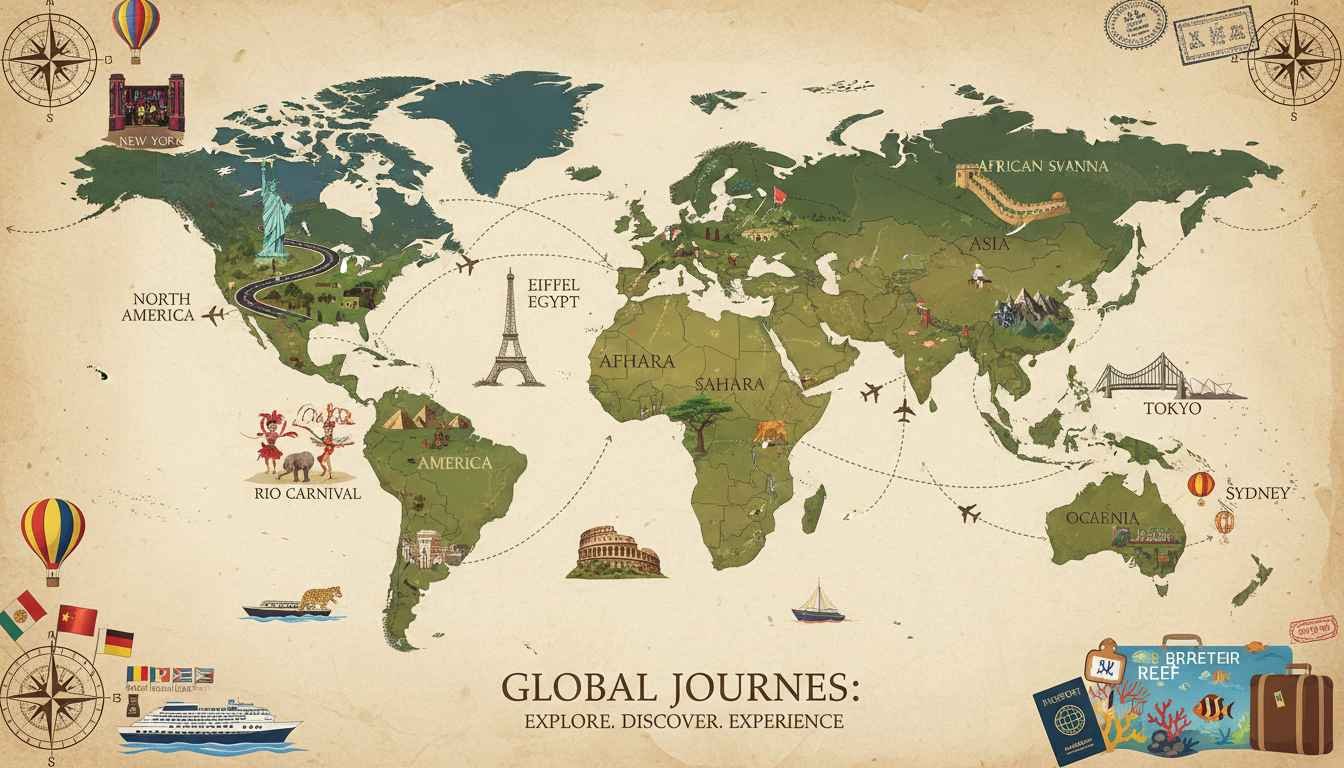
The world is too big for one trip, but it is not too big for one list. This guide offers a list of places to visit in the world for travel and cultural experiences, organised by region, so you can pick the places that match your interests — history, nature, food, art or adventure — and start building an itinerary from there.
Europe: History on Every Corner
Europe packs an extraordinary amount of history into a small area, and our guide to the best places in Europe to visit covers its highlights in more depth. Italy offers Rome’s ancient ruins, Florence’s Renaissance art and Venice’s canals. France pairs Paris’s museums and boulevards with the chateaux of the Loire and the villages of Provence. Spain combines Barcelona’s modernist architecture with Granada’s Alhambra and Seville’s flamenco culture.
Further north, London’s ten best places to visit, its free museums and theatre district, Amsterdam’s canals and the Scottish Highlands offer a different kind of European experience — greener, quieter and just as rich.
North America: Cities and Wilderness
North America spans everything from Manhattan’s skyline to Canada’s national parks. New York City remains the continent’s great urban experience, and it anchors most lists of the top 15 places to visit in the United States, while Washington DC’s free museums and monuments make it one of the best-value city breaks anywhere.
Mexico adds ancient Maya and Aztec sites in the Yucatan, colonial cities such as Oaxaca, and Pacific and Caribbean beaches. Canada’s contribution is landscape on a grand scale: Banff, Jasper and the Atlantic coast, alongside the French-speaking culture of Quebec City and Montreal.
Asia: Ancient Traditions and Modern Cities
Asia offers the greatest contrasts of any region. Japan blends Kyoto’s temples and gardens with Tokyo’s neon districts and efficient rail network. India pairs the Taj Mahal and Rajasthan’s palaces with the backwaters of Kerala and the Himalayan foothills.
China’s Great Wall, historic Xi’an and modern Shanghai show a civilisation of extraordinary depth, while Southeast Asia — Thailand’s temples and islands, Vietnam’s Ha Long Bay and Hanoi’s old quarter, Bali’s rice terraces — remains one of the world’s best-value regions for travellers.
The Middle East: Ancient Cities and Desert Landscapes
The Middle East rewards travellers who look beyond the headlines. Jordan’s Petra, carved into rose-red cliffs, is one of the world’s great archaeological sites. Egypt’s pyramids, Luxor’s temples and the Nile have drawn travellers for millennia. Dubai and Abu Dhabi offer a modern contrast: futuristic skylines, desert excursions and world-class museums.
Africa: Wildlife and Living Cultures
Africa’s great draw is wildlife on a scale found nowhere else. Kenya and Tanzania offer safaris in the Masai Mara and Serengeti, where the annual wildebeest migration is one of nature’s great spectacles. South Africa combines safari parks with Cape Town’s mountains, vineyards and Table Mountain.
North Africa adds a different dimension: Morocco’s medinas in Marrakech and Fez, Egypt’s ancient sites, and the desert landscapes of the Sahara.
Oceania: Islands, Reefs and Open Space
Oceania is defined by distance and nature. Australia’s Great Barrier Reef, Sydney’s harbour and the Red Centre offer three very different versions of the same country. New Zealand pairs fjords, mountains and Maori culture in a compact, road-trip-friendly package.
The Pacific islands — Fiji, Samoa, French Polynesia — offer a slower rhythm: lagoons, reefs and village life, best enjoyed with time to spare.
South America: Mountains, Rainforest and Great Cities
South America combines natural wonders with vibrant urban culture. Peru’s Machu Picchu, reached by train or on foot along the Inca Trail, is the continent’s most famous site. Brazil offers Rio’s beaches and Carnival, the Amazon rainforest and the colonial streets of Salvador.
Argentina adds Buenos Aires’ tango and cafe culture, Patagonia’s glaciers and the Iguazu Falls, shared with Brazil, which many travellers rate as the world’s most impressive waterfall system.
How to Use This List
Do not try to see everything. Pick one region, then pick three or four places within it that genuinely excite you, and give each of them proper time. The best trips are rarely the ones that cover the most ground — they are the ones that go deep enough in a few places to understand them.
Consider the season, the cost and the kind of traveller you are. A history lover will get more from Rome than from a beach resort; a nature lover will get more from Patagonia than from a capital city. Let your interests, not a checklist, decide.
Frequently Asked Questions
What are the main attractions on a world travel list?
Historical landmarks, natural parks, mountains, beaches and cultural cities — the mix depends on the region, but the best lists balance all of them.
When is the best time to travel the world?
Spring and autumn are generally the most comfortable seasons in most regions, but the ideal months vary: Southeast Asia is best in its dry season, Patagonia in its summer, and Europe in late spring or early autumn.
Is world travel suitable for families?
Yes. Many of the places on this list — national parks, historic cities, beaches and museums — are family-friendly, and travelling slowly with children often leads to the most memorable trips.
How do you plan a multi-continent trip?
Start with one region, choose a few anchor destinations, check visa and season requirements for each, and leave gaps in the itinerary for rest and discovery.
The world will not fit in a single journey, but a good list is a start. Choose your places, travel slowly, and let each destination earn its place in your memory.