
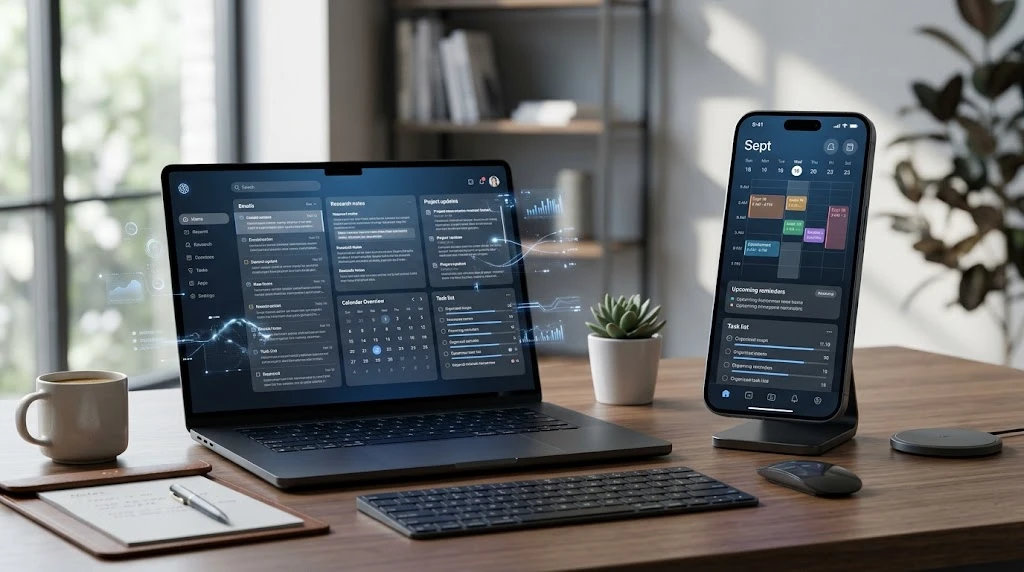
Artificial intelligence is changing the way people organize work, manage information, communicate, and handle everyday responsibilities. The latest generation of AI assistant apps is going beyond answering questions or setting basic reminders. These tools can increasingly help users research information, organize schedules, draft communications, manage repetitive tasks, and coordinate activities across multiple digital services.
That shift raises an interesting question: could a new AI app eventually replace some of the work traditionally handled by a personal assistant?
The answer depends on what tasks need to be completed. AI can already handle many repetitive and information-heavy activities, but human assistants continue to provide judgment, relationship management, discretion, and context that software cannot always reproduce.
What Makes the New Generation of AI Assistants Different?
Older digital assistants were mainly designed to respond to simple commands. You could ask for the weather, set a timer, create a reminder, or perform a basic search. Modern AI assistants are moving toward a more capable model in which the system can understand a broader request, break it into steps, and help execute those steps.
For example, instead of simply asking an assistant to create a reminder, a user might ask it to organize a busy afternoon, identify scheduling conflicts, prepare a list of priorities, and draft messages related to upcoming commitments.
This development is closely connected to the growth of AI agents. Unlike a conventional chatbot that primarily generates an answer, an AI agent can use connected tools and services to work toward a larger goal.
That makes the technology particularly interesting for people already adopting digital transformation across their personal and professional workflows.
AI Can Take Over Repetitive Administrative Work
One of the strongest arguments for AI personal assistants is their ability to reduce repetitive administrative work.
Consider the everyday tasks that consume time:
- Sorting information and messages
- Creating summaries
- Drafting routine emails
- Organizing appointments
- Preparing checklists
- Researching products or services
- Creating travel plans
- Turning notes into structured documents
- Finding information across multiple sources
- Preparing reminders and follow-up tasks
These activities often follow recognizable patterns. That makes them suitable for automation, particularly when the user can review important actions before anything is finalized.
The same automation mindset is already visible in other areas of consumer technology. For example, smart home devices can automate household routines, while AI assistants can increasingly automate parts of a person’s digital routine.
From Chatbot to Personal AI Agent
The biggest change is not simply that AI has become better at answering questions. It is that AI systems are increasingly being designed to take action.
A modern personal AI agent may be able to interpret a request, gather relevant information, create a plan, and interact with connected applications. Depending on the product and permissions available, that could include working with calendars, email, documents, communication tools, or other online services.
This creates a major difference between asking AI, “What should I do today?” and asking it to help organize the actual tasks that make up the day.
For professionals, this could make AI particularly useful as a layer between different digital tools. Instead of manually switching between applications, the user could increasingly rely on one intelligent interface to coordinate routine work.
Why Busy Professionals Are Paying Attention
Time management is one of the clearest areas where AI assistants can provide practical value.
A freelancer might use AI to organize client requests. A business owner could use it to prepare meeting notes and follow-up messages. A researcher might use it to summarize large amounts of information. A remote worker could use it to coordinate schedules and prioritize tasks.
People working on side hustles and independent businesses may also benefit because they often have to perform many different roles themselves.
Instead of hiring help for every small administrative task, an AI assistant can potentially reduce the amount of manual work involved.
AI Assistants Can Also Help With Research
Research is another area where AI assistants are becoming increasingly useful.
A traditional workflow might require opening multiple websites, comparing information, taking notes, organizing findings, and then creating a summary. AI can help compress several of those steps into one workflow.
That does not mean every AI-generated answer should be accepted without checking. AI systems can make mistakes, misunderstand instructions, or present outdated information. Important financial, legal, medical, or business decisions still require appropriate human verification.
For everyday research, however, AI can serve as a powerful first layer for gathering and organizing information.
The Connection Between AI and Digital Productivity
The growing AI assistant market is part of a broader shift toward connected digital productivity.
Businesses are already investing in digital strategies and automation to reduce repetitive work and improve efficiency. AI assistants extend the same idea into individual workflows.
Instead of automation being limited to large companies, individuals can increasingly use intelligent software to manage parts of their own working environment.
This is particularly relevant as more people work remotely, operate online businesses, manage multiple projects, and communicate across different platforms.
What About Email and Calendar Management?
Email and scheduling are two areas where AI assistants could have a noticeable impact.
An intelligent assistant can potentially summarize long conversations, identify action items, draft responses, organize meetings, and highlight scheduling conflicts.
Calendar management is especially suitable for automation because many scheduling decisions follow clear rules. A system can consider availability, priorities, deadlines, and preferences before suggesting an arrangement.
However, a human should still remain in control of important commitments. Automatically sending a message or changing a major appointment without confirmation can create unnecessary problems.
AI Could Become the Interface for Multiple Apps
Another important development is the possibility of using AI as a central interface for multiple digital services.
Instead of opening one application for email, another for calendars, another for notes, and another for research, users could eventually communicate their intent through one AI interface.
This resembles the broader evolution of connected technology. Just as smartphones brought many separate functions into one device, AI assistants could bring multiple digital workflows into one conversational layer.
The trend also connects with developments in modern technology platforms that increasingly connect software, hardware, data, and services.
What AI Still Cannot Easily Replace
Despite impressive progress, replacing a human personal assistant completely is a much bigger challenge.
A skilled human assistant does much more than complete repetitive tasks. They can understand relationships, recognize subtle changes in someone’s priorities, handle sensitive situations, communicate with other people, and make judgment calls based on context.
Human assistants can also notice things that may not be explicitly stated. They might understand why a particular meeting should be moved, recognize that a client needs special attention, or know how a person prefers to communicate with different contacts.
Those qualities are difficult to reproduce reliably with software.
Privacy Is a Major Consideration
The more capable an AI assistant becomes, the more information it may need to access.
A truly useful personal assistant could potentially interact with email, calendars, documents, contacts, shopping accounts, and other personal services. That creates an important privacy and security question.
Users should understand what information an application can access, what permissions it requires, how credentials are protected, and whether important actions require confirmation.
The same principle applies when using other connected digital services, including digital payment wallets and online financial platforms.
Convenience should not automatically mean giving an application unlimited access to personal information.
AI Assistants Will Need Human Oversight
The most practical future may not be humans versus AI. It may be humans working alongside AI.
In that model, AI handles repetitive tasks while people remain responsible for decisions that require judgment, empathy, creativity, accountability, or sensitive communication.
For example, an AI assistant could prepare a meeting agenda, summarize previous conversations, identify open tasks, and draft follow-up emails. The user could then review the material before sending anything.
This approach combines automation with human control.
AI Could Change the Meaning of a Personal Assistant
Instead of thinking about AI as a direct replacement for a human employee, it may be more useful to think of it as a new category of productivity infrastructure.
An AI assistant can potentially provide support at a much lower marginal cost and remain available whenever the user needs help. That makes it attractive to freelancers, entrepreneurs, students, remote workers, and small businesses.
The growing importance of information technology and connected digital services will likely make these systems even more useful as more tasks move online.
Other Technologies Are Moving in the Same Direction
AI assistants are not developing in isolation. They are part of a larger technology ecosystem where software is becoming increasingly automated and interconnected.
Businesses are exploring new ways to improve efficiency through automation, intelligent software, connected devices, and data-driven decision-making.
Readers interested in this broader technology shift can also explore topics such as technology-driven business solutions, business technology and efficiency, and advanced sensor technology.
Even consumer electronics are becoming smarter. For example, choosing the right noise-canceling headphones is no longer simply about sound quality; modern devices increasingly integrate intelligent features, connectivity, and adaptive controls.
Could AI Actually Replace Your Personal Assistant?
For some users, AI may already be capable of handling a significant portion of routine administrative work. For others, particularly people who depend on relationship management and complex judgment, human assistance remains difficult to replace.
The more realistic near-term scenario is a hybrid approach.
AI handles scheduling suggestions, research, summaries, routine communications, organization, and repetitive digital tasks. Humans handle sensitive decisions, relationships, negotiation, leadership, and situations where context matters more than automation.
As AI agents become more capable, the dividing line between “assistant” and “software” may become increasingly difficult to define.
The Future of Personal Productivity
The emergence of AI personal assistants represents a major change in how people interact with technology. Instead of learning how to operate dozens of applications, users may increasingly tell an intelligent system what outcome they want and allow it to coordinate the necessary steps.
That could make technology feel less like a collection of separate tools and more like an intelligent personal workspace.
At the same time, users will need to remain aware of accuracy, privacy, security, permissions, and human oversight.
The future is therefore unlikely to be as simple as “AI replaces every personal assistant.” A more realistic development is that AI takes over an expanding share of repetitive digital work while human assistants focus on tasks where judgment, trust, communication, and personal understanding remain essential.
Final Thoughts
The new generation of AI assistant apps is changing expectations around productivity. These systems are becoming capable of more than answering questions: they can help organize information, coordinate workflows, support research, draft communications, and interact with connected digital services.
For people whose daily workload contains a large amount of repetitive administration, an AI assistant could become a remarkably useful productivity partner.
But replacing a human personal assistant entirely is a different question. Human judgment and interpersonal understanding still matter, particularly when decisions involve sensitive information, relationships, or unpredictable circumstances.
The real opportunity may therefore be found in collaboration. Let AI handle the repetitive digital workload, while people remain responsible for the decisions and relationships that require a human touch.