Bringing home a puppy is pure joy — and pure chaos. Those first weeks set the tone for the next decade of your life together, and the difference between a well-mannered dog and a furry tornado comes down to training. The good news is that you do not need to be a professional trainer. With consistency, patience, and the right approach, these ten puppy training basics will give your new companion the foundation every good dog needs.
Start training on day one. Puppies as young as eight weeks can learn simple commands, and every day you wait is a day your puppy practices the wrong habits on their own.
Before the First Command: The Rules of Puppy Training
Training works only when the rules are clear and consistent. Keep sessions short — five to ten minutes, two or three times a day. Puppies have tiny attention spans, and ending on a win beats drilling until they check out.
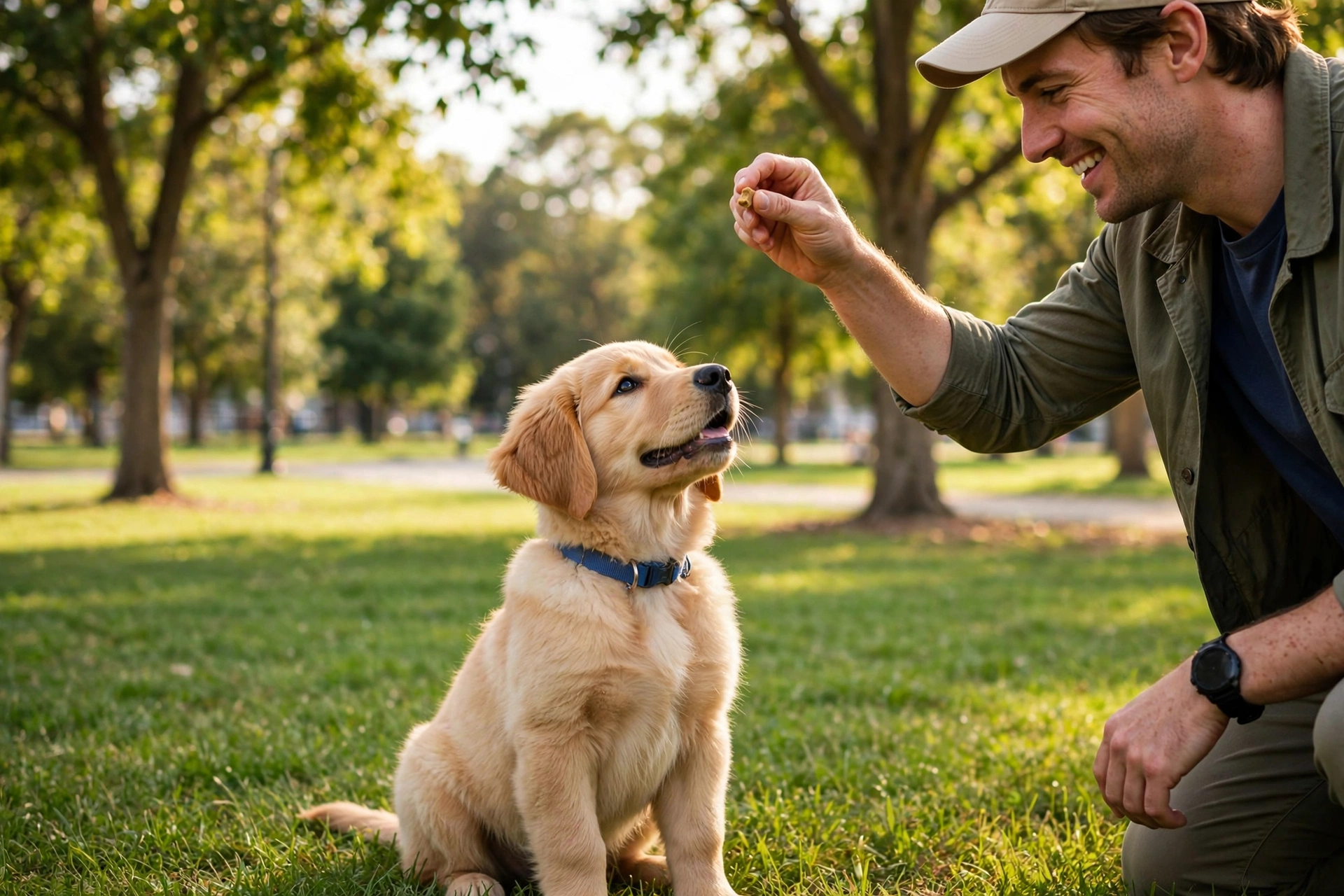
Use positive reinforcement: reward the behavior you want with treats, praise, or play, and ignore or redirect the behavior you do not want. Punishment after the fact just confuses a puppy. Everyone in the household must use the same words and the same rules, or your puppy will learn that “no” means different things to different people.
And remember: a tired puppy learns faster. A short play session before training burns off the wiggles and sharpens focus.
1. Sit
“Sit” is the foundation of nearly everything else. Hold a treat just above your puppy’s nose, then move it slowly back over their head. As their nose follows the treat up, their bottom naturally drops down. The moment it touches the ground, say “Sit,” praise enthusiastically, and deliver the treat.
Practice this before meals, before going outside, and before greeting visitors. A dog that sits on command is a dog that can be managed in almost any situation.
2. Stay
Ask your puppy to sit, then hold your palm out like a stop sign and say “Stay.” Take one step back. If they hold position for even two seconds, return, praise, and treat. Gradually increase the distance and duration — but build slowly. Rushing this one is the most common beginner mistake.
“Stay” is a safety command as much as a manners command. It is what keeps your puppy from bolting out an open door or into a busy street.
3. Come (Recall)
Recall can literally save your dog’s life, so make it the most rewarding word in their vocabulary. Crouch down, open your arms, and say “Come” in a happy voice. When your puppy runs to you, throw a party — big praise, the best treats, genuine excitement.
Never call your puppy to you for something unpleasant (like a bath or nail trim). “Come” must always predict wonderful things, or your puppy will learn to think twice.
4. Down
“Down” teaches impulse control. With your puppy in a sit, hold a treat at their nose and lower it slowly to the floor between their paws, then slide it slightly forward. Most puppies will lie down to follow it. Mark the moment with “Down,” praise, and treat.
This command is gold for settling an excited puppy — at the vet’s office, at a café, or when guests arrive.
5. Leave It
Hold a treat in your closed fist and let your puppy sniff and paw at it. The moment they pull back, even slightly, say “Leave it,” praise, and reward them with a *different* treat from your other hand. They learn that ignoring the forbidden thing earns something better.
“Leave it” protects your puppy from dropped food, trash on walks, and genuinely dangerous items like chicken bones or medication.
6. Drop It
Trade, don’t grab. Offer your puppy a toy, let them take it, then present a high-value treat near their nose and say “Drop it.” When they release the toy, treat and praise — then give the toy back. Giving the toy back teaches them that dropping things does not mean losing them forever.
This is essential for puppies who love to “steal” socks, shoes, and anything remotely chewable.
7. Loose-Leash Walking Basics
Start indoors where distractions are low. With your puppy on a leash, take a step; if the leash stays loose, treat. The instant they pull, stop dead. Only move forward when the leash slackens. Your puppy quickly learns a simple equation: pulling stops the fun, walking nicely keeps it going.
Keep early walks short and positive. A puppy that learns leash manners now will not be dragging you down the street at 30 kilos later.
8. Place (Go to Your Bed)
Choose a mat or bed as your puppy’s “place.” Lure them onto it with a treat, say “Place,” and reward them for all four paws on the mat. Gradually extend the time they stay there before the reward comes.
“Place” gives your puppy a job during dinner, when the doorbell rings, or whenever you need them settled but nearby. It is one of the most useful real-life commands you will ever teach.
9. Off (Four Paws on the Floor)
Puppies jump — it is how they say hello. Teach “Off” by turning away and ignoring the jumping completely, then rewarding the instant all four paws hit the floor. Say “Off” as the paws land, so the word predicts the reward.
Never reward jumping with attention, even negative attention. Pushing a jumping puppy away still counts as exciting contact in their mind.
10. Their Name (Attention Cue)
Your puppy’s name should mean “look at me” — the gateway to every other command. Say their name once; the moment they glance at you, mark it with “Yes!” and treat. Repeat a handful of times per session.
If your puppy ignores their name, do not repeat it louder and louder. That just teaches them that the first five times do not count. Go back to rewarding eye contact and rebuild.
Handling the Big Three Puppy Problems
Biting and nipping:
Puppies explore with their mouths. When teeth touch skin, yelp or say “ouch” in a neutral tone and briefly withdraw attention. Resume play when they are calm. Consistency across the household fixes this faster than any gadget.
House training:
Take your puppy out after waking, eating, playing, and every one to two hours in between. Praise and treat outdoor success like they just won a prize. Accidents indoors are your scheduling failure, not their defiance — clean them with enzymatic cleaner and tighten the routine.
Crate training:
Make the crate a den, not a jail. Feed meals inside it, toss treats in randomly, and never use it for punishment. A properly introduced crate becomes your puppy’s favorite safe spot — and your secret weapon for house training.
When to Get Professional Help
Most owners can handle the basics above, but call a certified trainer if your puppy shows genuine aggression (stiff body, hard stare, growling over resources), extreme fear that does not improve, or behaviors that escalate despite consistent training. Early professional guidance on serious issues is far cheaper — and kinder — than fixing entrenched problems later.
If your schedule means long days away, look into reputable pet boarding and daycare options so your puppy is not practicing bad habits alone all day, and explore services built for pet lovers that can support your routine.
The Bottom Line
Puppy training basics are not about perfection — they are about communication. Ten short sessions a week, honest consistency, and generous rewards will transform your chaotic little newcomer into a confident, well-mannered companion. Start today, keep it fun, and enjoy the process: these early weeks are the foundation of everything, and they go by fast.