
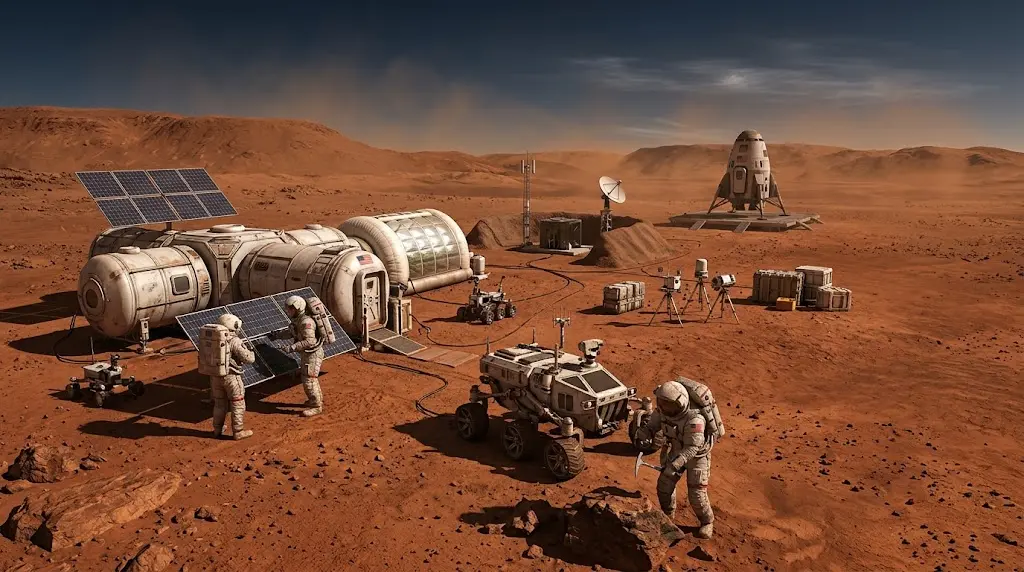
NASA is approaching that challenge through its Moon to Mars Architecture, an evolving framework that connects lunar exploration with future human missions to the Red Planet. Rather than treating a Mars landing as one isolated mission, NASA is developing capabilities progressively through lunar missions, technology demonstrations, architecture studies, and partnerships with industry and international organizations.
NASA’s Mars Mission Is Part of a Larger Strategy
The first human mission to Mars is not being planned as a single launch followed by an immediate landing. NASA’s current architecture is divided into major segments that progressively increase exploration capability.
The architecture includes Human Lunar Return, Foundational Exploration, Sustained Lunar Evolution, and Humans to Mars. The final segment focuses on establishing the capabilities required to travel to Mars, land safely, operate on the surface, and eventually return astronauts to Earth.
This gradual approach is important because many technologies required for Mars can be tested closer to Earth first. NASA’s Artemis program and lunar activities provide opportunities to learn how humans and hardware perform farther from Earth before the agency commits to a much longer Mars expedition.
The same principle can be seen across modern technology development. Complex systems are usually built from interconnected components rather than one enormous technological leap. PostTrek’s coverage of modern technology infrastructure provides a useful example of how communications, connectivity, security, and physical systems work together as an integrated environment.
Why the Moon Matters Before Mars
The Moon is considerably closer to Earth than Mars, making it a practical environment for testing technologies and operational procedures intended for deeper space.
NASA’s Moon-to-Mars strategy uses lunar exploration to develop capabilities involving transportation, communications, power, habitation, surface mobility, logistics, and human operations. The agency describes Artemis as a key step toward future Mars missions.
Lunar missions can also help engineers identify problems before they become Mars-scale problems. A technology that fails during a lunar demonstration may be redesigned relatively quickly. A comparable failure hundreds of millions of miles from Earth would be much more difficult to resolve.
This systems-based approach is also reflected in PostTrek’s article about Dante controller technology, where communications and connected systems demonstrate the importance of reliable infrastructure in complex technical environments.
Getting Astronauts to Mars
Transportation is one of the biggest challenges in a human Mars mission. NASA’s Mars architecture trade space currently considers multiple propulsion approaches rather than presenting one final transportation system as the only possible solution.
Potential approaches include chemical propulsion, nuclear thermal propulsion, nuclear electric systems, solar-electric approaches, and hybrid architectures. Each involves different trade-offs involving speed, mass, technology maturity, energy requirements, mission duration, and complexity.
A Mars transportation system must do more than simply leave Earth. It must carry people and equipment across interplanetary space, support them for a long-duration journey, and ultimately enable the crew to reach Mars safely.
NASA’s architecture therefore treats transportation as one component of a larger system that includes communications, habitation, logistics, power, mobility, and surface operations.
Landing Humans on Mars Is a Major Engineering Problem
Landing a robotic spacecraft on Mars is already difficult. Landing a large vehicle carrying humans presents an even greater challenge.
Mars has an atmosphere, but it is much thinner than Earth’s. That creates a complicated entry, descent, and landing environment. A human mission would require a system capable of safely slowing and landing substantially more mass than many robotic spacecraft have delivered to the Martian surface.
NASA’s Mars architecture studies examine the size of landing vehicles, atmospheric entry, descent systems, landing sequence, and the amount of equipment that needs to arrive before or with the crew.
This is another example of why Mars exploration depends on advanced technology working together. Sensors, autonomous systems, communications, navigation, propulsion, thermal protection, and software all have to function during a highly constrained sequence.
Readers interested in the broader role of advanced sensing technology can also explore PostTrek’s coverage of advanced sensor technology.
How Astronauts Could Live on Mars
Reaching Mars is only the beginning. Once astronauts arrive, they must survive and work in an environment that is extremely different from Earth.
NASA identifies habitation, food, water, oxygen, power, communications, spacesuits, and surface mobility among the technologies needed to support human exploration.
A Mars habitat would need to maintain a pressurized environment while protecting astronauts from external hazards. It would also need systems for recycling resources and supporting everyday activities for an extended period.
NASA is researching technologies that can regenerate or recycle consumables such as air and water. It is also studying food systems capable of supporting astronauts when conventional resupply from Earth is not practical.
The importance of connected systems becomes especially obvious here. A Mars habitat would essentially function as a sophisticated technological ecosystem in which power, environmental control, communications, computing, sensors, and human operations constantly interact.
Power on Mars Could Depend on Nuclear Fission
Reliable energy is essential for a human Mars mission. Astronauts would need power for habitats, communications, scientific equipment, environmental systems, vehicles, resource processing, and other mission infrastructure.
NASA selected nuclear fission as the primary surface power generation technology for initial human Mars missions. One reason is that Martian dust storms can last for extended periods, making dependence on sunlight more complicated than it would be in many Earth-based environments.
A nuclear surface power system could provide continuous energy independent of the day-night cycle and weather conditions that affect solar generation.
NASA’s decision is part of an ongoing architecture-development process rather than evidence that every technical detail of a future Mars power system has already been finalized.
Communications Will Be Very Different From Earth
Communication between Mars and Earth introduces another fundamental challenge: distance.
Signals cannot travel instantly between the two planets. Depending on their relative positions, communication can involve significant delays, while certain conditions can create periods of communication disruption.
That means astronauts cannot depend on Earth-based mission controllers for every decision. Future crews will require greater autonomy, robust onboard computing, reliable navigation, and carefully designed communication systems.
NASA’s architecture research specifically identifies communications disruption and delay as important considerations for crewed Mars exploration.
This emphasis on autonomous systems also connects with PostTrek’s coverage of AI and autonomous technology. While a consumer AI assistant and a Mars mission are obviously very different applications, both illustrate the broader importance of software capable of supporting decisions and operations when human intervention is limited.
Robotics Will Support Human Exploration
Humans are unlikely to work alone on Mars. Robots and autonomous systems can perform reconnaissance, transport equipment, collect information, prepare work areas, and support scientific operations.
NASA’s Moon-to-Mars architecture includes autonomous systems and robotics as one of its major sub-architectures. These technologies can help reduce the workload placed on astronauts and allow certain operations to continue without direct human control.
The relationship between humans and machines will therefore be an important part of future Mars exploration. Robots can handle repetitive or hazardous tasks while astronauts focus on scientific investigation, decision-making, maintenance, and activities requiring human judgment.
PostTrek’s coverage of technology-driven business solutions and technology for operational efficiency provides additional context on how automation and connected systems are changing complex operations on Earth.
What Happens After Landing?
A successful landing would not mark the end of the mission. Astronauts would need to establish a safe working environment, maintain life-support equipment, conduct scientific activities, manage supplies, and prepare for the return journey.
Surface mobility would be especially important. Mars is a large planet, and scientific objectives may require astronauts to travel beyond the immediate landing area. NASA’s architecture therefore includes mobility systems capable of moving both crew and cargo.
Infrastructure could also become increasingly important as missions evolve. Early missions may have limited capabilities, while later missions could introduce additional habitats, power systems, communications infrastructure, scientific equipment, and resource-utilization technologies.
Using Resources on Mars
One of the most important concepts in long-duration Mars exploration is in-situ resource utilization, commonly called ISRU.
The basic idea is to use resources available at the destination rather than transporting everything from Earth. NASA’s architecture identifies ISRU as a major sub-architecture for Moon-to-Mars exploration.
For Mars missions, resource utilization could potentially reduce the amount of material that must be launched from Earth. NASA has already demonstrated an important related technology with MOXIE, which produced oxygen from the Martian atmosphere aboard the Perseverance rover.
Future resource systems could become important for producing mission consumables and supporting longer-duration operations, although the exact role of these systems in the first human Mars mission remains part of ongoing planning and technology development.
Protecting Astronaut Health
A human mission to Mars would expose astronauts to risks that are significantly different from those experienced during shorter missions near Earth.
NASA identifies radiation, changing gravity, isolation, distance from Earth, and environmental conditions among the major human-health considerations for Mars missions.
The distance from Earth also changes the meaning of emergency response. On the International Space Station, astronauts can receive extensive support from Earth and return relatively quickly compared with an interplanetary mission. A Mars crew would operate much farther away, with much longer communication delays and limited emergency options.
NASA’s Mars architecture therefore considers human health and performance as a central component of mission design rather than treating astronaut safety as a separate issue.
Technology Development Is Happening Across Many Fields
The Mars mission is not dependent on one breakthrough invention. It requires progress across numerous technical disciplines.
These include propulsion, robotics, artificial intelligence, sensors, communications, materials, power generation, life support, navigation, computing, manufacturing, medicine, food systems, and autonomous operations.
PostTrek’s technology coverage illustrates several of these broader trends, including smart connected devices, digital transformation, and digital manufacturing systems.
Other PostTrek technology articles, including coverage of information technology’s global impact and technology-enabled business operations, provide additional examples of how interconnected digital systems are becoming part of increasingly complex environments.
Why the First Mars Mission Will Be So Complex
The biggest challenge is not any individual component. It is the need for all of the components to operate together for a mission lasting far longer than a typical Earth-orbit expedition.
A Mars mission must account for transportation, navigation, communication, power, landing, habitation, food, water, oxygen, surface mobility, science, maintenance, radiation protection, autonomy, and the eventual journey home.
NASA describes this as a system-of-systems challenge. Decisions in one area can affect many others. Increasing crew size can increase habitat requirements. More surface exploration can increase mobility and power requirements. Longer missions can increase logistics and life-support demands.
That is why NASA continues to evaluate different architectural possibilities instead of treating the first human Mars mission as a completely fixed design.
When Could Humans Reach Mars?
NASA’s current public materials discuss advancing technologies that could support human missions to Mars as early as the 2030s, but the agency’s architecture remains under development.
A specific launch date depends on numerous technical, operational, budgetary, and programmatic decisions. NASA’s architecture process is designed to evolve as technology, priorities, discoveries, and mission requirements change.
For that reason, it is more accurate to describe the first human Mars mission as an active long-term development effort rather than a fully scheduled expedition with every element already finalized.
What the First Human Mars Mission Could Teach Us
A crewed Mars expedition would have scientific importance beyond simply demonstrating that humans can travel to another planet.
Scientists could investigate the Martian environment directly, study geological history, search for evidence relevant to past microbial life, and improve understanding of how planetary environments evolve.
The mission would also provide an unprecedented test of human performance and technological independence far from Earth. Technologies developed for Mars could influence future deep-space exploration, robotics, resource utilization, communications, energy systems, and autonomous operations.
For readers interested in the broader relationship between technology and innovation, PostTrek’s technology and science coverage offers additional perspectives on emerging systems and technological change.
Final Thoughts
NASA’s first human mission to Mars is best understood as a long-term campaign rather than a single spacecraft waiting on a launchpad. The agency is building an evolving Moon-to-Mars architecture that connects lunar exploration with the much harder challenge of sending people to another planet.
Transportation, landing systems, nuclear power, communications, autonomous systems, habitats, resource utilization, robotics, food, water, and astronaut health are all part of the equation.
The exact configuration of the first human Mars mission remains under development. What is already clear is that reaching Mars safely will require many technologies to work together as one highly integrated system.
As NASA continues refining its architecture, lunar missions and technology demonstrations will provide opportunities to test capabilities before they are needed for the much longer journey to the Red Planet. The eventual first human footsteps on Mars will therefore represent not one technological breakthrough, but the culmination of decades of engineering, scientific research, testing, and incremental exploration.